Why manual, white-glove service for your first 10 customers is the fastest path to product-market fit (and how it teaches you what to automate later)
·11 min read
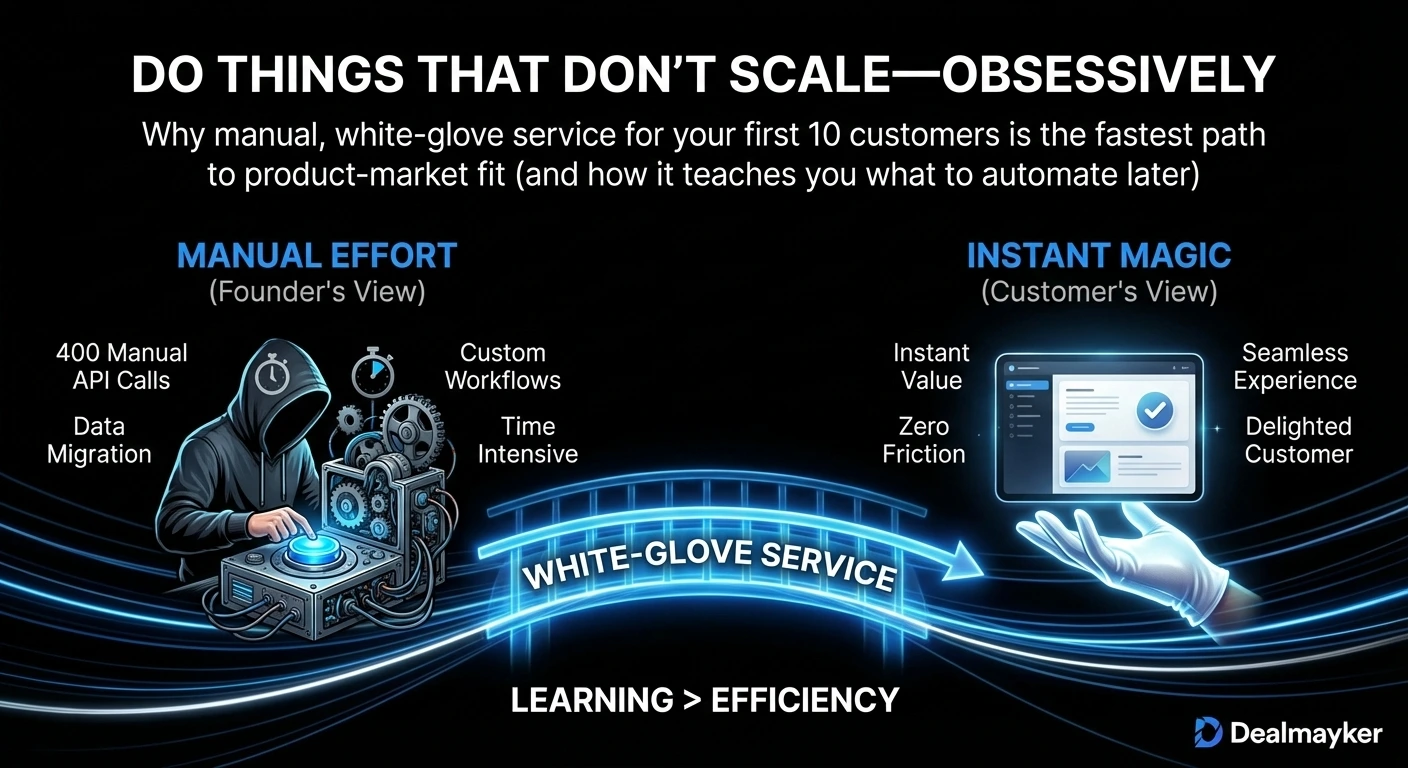
For my first customer at my current company, I manually triggered a Postman API call 400 times.
With a stopwatch.
55 seconds between each call because of API rate limits.
That took hours. It wasn't scalable. It wasn't efficient. It wasn't "best practice."
But when my customer logged in, everything was ready. It felt instant. They got immediate value.
That's white-glove service - doing whatever it takes to make your early customers wildly successful, even if it means spending days on manual work they never see.
Here's why this "inefficient" approach is actually the fastest path to product-market fit - and how to do it without burning out.
Why White-Glove Service Matters for Early Customers
When you have your first 1, 5, or 10 customers, efficiency is your enemy.
Every founder's instinct is to think: "How do I make this scalable?"
But here's what you should actually be asking: "What can I learn from this customer that will help me build something people actually want?"
White-glove service isn't just about making customers happy (though that matters). It's about creating an environment where you learn everything possible about how they use your product, what they struggle with, what delights them, and what they actually need.
The reality:
The feedback loop from your first customer is worth more than a thousand website visitors. When you get somebody actually using the product, telling you all the angles, asking questions, explaining how it fits into their workflow - that's how you learn the most about your product.
You can't learn this from analytics dashboards or support tickets. You learn it from being deeply involved in every customer's journey.
From the Video(08:17-08:46)
Once you have that first customer, your job isn't to optimize or automate, it's to become obsessed with their success. I don't care if they are paying you $20 a month or $2,000 a month, you treat them like they are your only customer because right now they are. Nothing else matters, just making them happy.
Key Takeaway: The Core Principle
White-glove service for early customers is about learning, not customer service. The insights you gain will shape your product, sales process, and automation strategy for the next 100 customers.
What White-Glove Service Actually Looks Like
White-glove service means doing everything for your customer - even the things you eventually want them to do themselves.
Here's what I mean:Setup and onboarding:
You do the complete setup yourself, don't send them a guide
You configure settings based on their specific use case
You create their account, set permissions, customize the interface
They log in and everything is already ready
Data migration:
You handle importing their existing data
You clean it, format it, map fields correctly
You verify everything is accurate
They see their data already in your system, working perfectly
Workflow creation:
You build initial workflows for them based on conversations
You create templates and examples relevant to their use case
You set up automations (even if you do them manually behind the scenes)
They experience the value immediately without setup friction
Proactive support:
You check in weekly (minimum) to see how things are going
You respond to questions within hours, not days
You fix issues immediately, often before they notice
You anticipate problems and solve them proactively
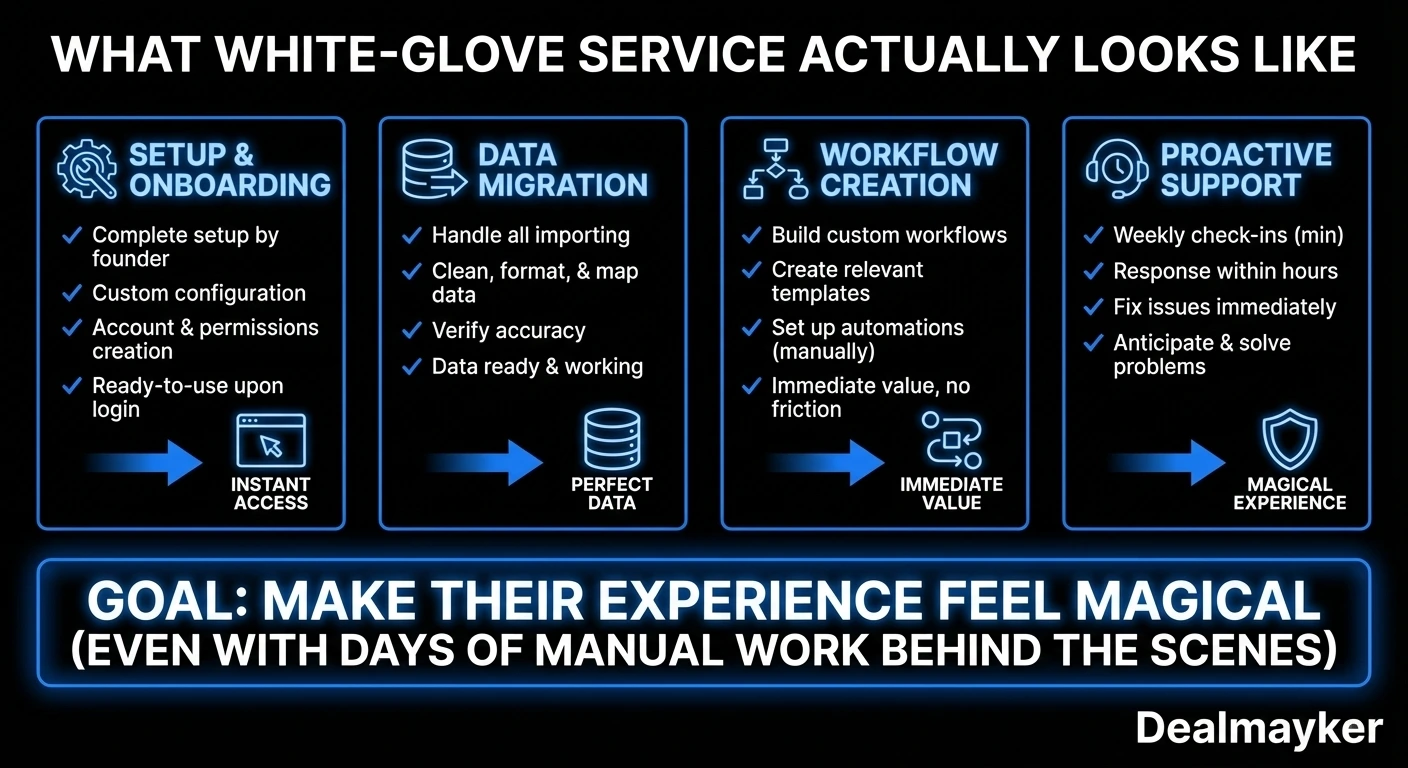
The goal: make their experience feel magical, even if you're doing days of manual work behind the scenes.
From the Video(08:46-09:13)
You need to onboard this customer personally, you check in weekly, you respond to their questions within hours, you ask them for feedback constantly. And this isn't about customer service, this is about learning what actually matters to people who pay for your solution.
Example: Real White-Glove Example
I personally helped with data migration, imports, many manual things in the background that customers haven't seen. There were instances where I would spend days, in previous company even weeks, for the first customer doing something in the background. When they came to the product, they had a feeling it was instant, even though it took me hours or days.
The 400 Manual API Calls Story (And Why It Was Worth It)
Let me tell you the full story of those 400 manual API calls.
For my first customer at DealMaker, they needed data from a specific source that I hadn't fully automated yet. The API had rate limits: one call every 55 seconds.
I had two options:
Option 1: Tell the customer "sorry, our automation isn't ready yet, you'll need to wait a few weeks while we build it properly."
Option 2: Sit there with Postman and a stopwatch, manually triggering API calls every 55 seconds for hours.
I chose Option 2.
Why?
Because I needed to learn:
Would the customer actually use this data once they had it?
How would they use it in their workflow?
What insights would they derive from it?
Would this feature be worth automating, or was it a nice-to-have?
After they got the data and used it for a week, I learned:
They used it daily (high value)
They wanted it formatted differently than I expected
They combined it with other data in a specific way
The "instant refresh" I thought they'd need wasn't actually important
Those insights shaped how I eventually automated it - and saved me from building the wrong automation.
The 400 manual API calls taught me more than any product spec or user interview could have.
From the Video(04:37-05:07)
For the current product, for my first customer, I triggered Postman API call 400 times. 400. Manually. Just by clicking and having a stopwatch to have 55 seconds in between because of the API limits.
Key Takeaway: The Learning ROI
Manual work that teaches you what customers actually need has infinite ROI. Premature automation based on assumptions has negative ROI - you build the wrong thing faster.
The Premature Optimization Trap
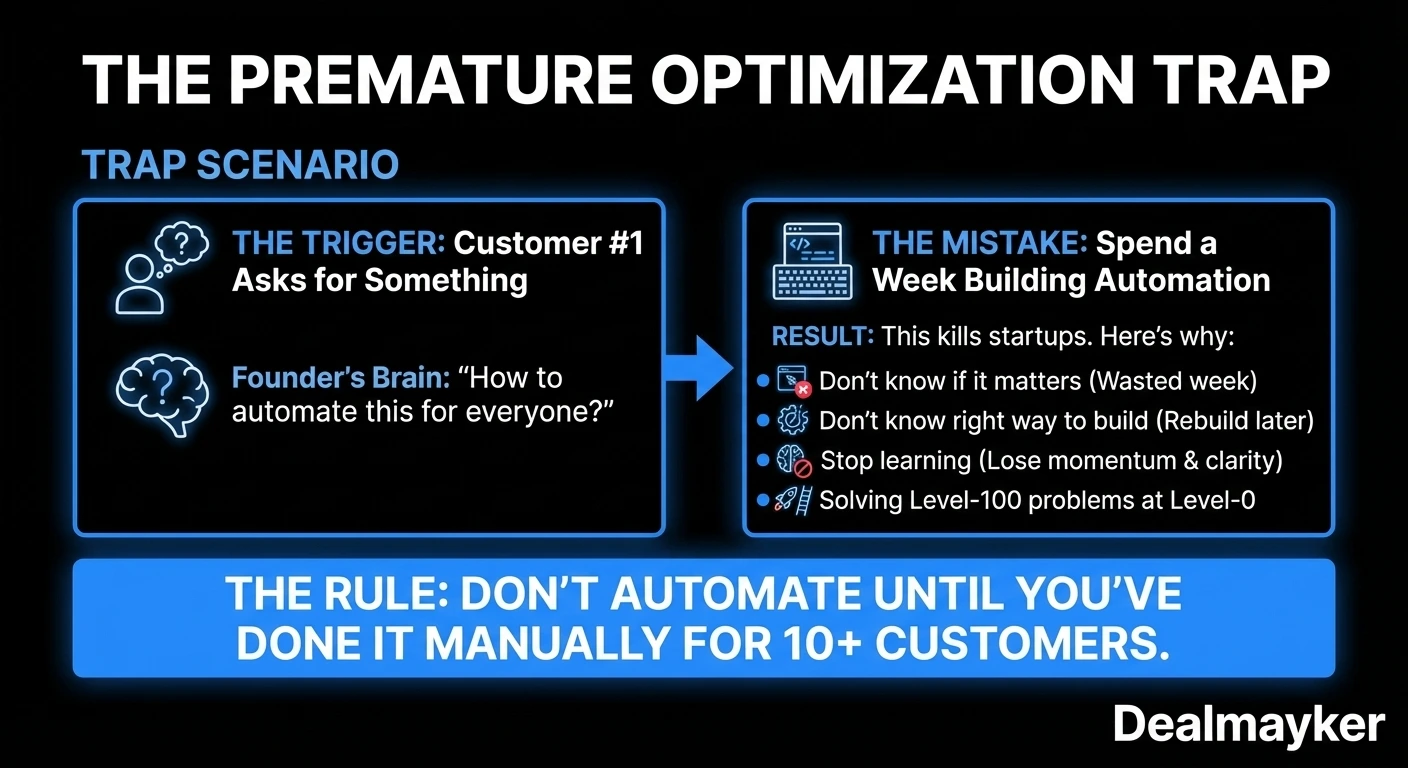
Here's the trap almost every founder falls into:
You get your first customer. They ask for something. Your brain immediately jumps to: "How do I automate this so I don't have to do it manually for customer #2, #3, #4?"
So you spend a week building automation before you even have customer #2.
This is premature optimization, and it kills startups.
Here's why:
1. You don't know if the feature actually matters yet
Maybe customer #1 needed it because of their specific edge case. Customers #2-5 might not need it at all. You just wasted a week automating something that isn't core to your value proposition.
2. You don't know the right way to build it yet
How customers #1-10 use a feature will teach you the right way to implement it. If you automate based on customer #1's feedback alone, you'll build it wrong and have to rebuild it later.
3. You stop learning
The minute you start optimizing for efficiency instead of learning, you stop getting the insights you need to build something people actually want to buy. You lose momentum and clarity about product-market fit.
4. You're solving level-100 problems at level-0
Automation is a level-100 problem. You're at level-0. You need to get to level-10 before automation makes sense.
The rule: Don't automate anything until you've done it manually for at least 10 customers. By then, you'll know what's actually worth automating and how to do it right.
From the Video(11:42-12:07)
There is a big temptation at this stage when you start thinking about how do I automate this. Don't do it. Think about it. It's good to know how to do stuff in the future, but don't do it yet. You haven't learned enough yet.
Common Mistake: The Efficiency Paradox
Optimizing for efficiency before understanding is incredibly inefficient. You build the wrong thing fast, realize it's wrong, and have to rebuild. Manual execution with deep learning is actually faster to product-market fit.
From the Video(11:42-12:07)
The minute you start optimizing for efficiency instead of learning, you stop getting those insights you need to build something people actually want to buy and you kind of lose the momentum.
How White-Glove Service Teaches You What to Automate
Here's the secret: white-glove service is actually research for your future automation.
Every manual task you do is teaching you:
Which tasks are actually important vs nice-to-have
What the edge cases are
Where customers get confused
What the logical workflow should be
What can be standardized vs what needs customization
The white-glove to automation progression:Customers 1-3: Do everything manually
Document what you do for each customer. Take notes on:
What questions do they ask?
What do they struggle with?
What delights them?
What takes the most time?
Customers 4-7: Start seeing patterns
Notice which manual tasks are identical across customers and which are custom. The identical tasks are automation candidates. The custom tasks need to stay manual (for now).
Customers 8-10: Document the repeatable parts
Create internal documentation (not yet customer-facing) of the standard workflow. This forces you to think through the logic and edge cases.
Customers 11-15: Build lightweight automation
Now - and only now - start building automation for the tasks you've done 10+ times and are truly identical each time. But keep the manual escape hatch for edge cases.
Customers 16-20: Create self-serve resources
Only after 15+ customers should you create customer-facing documentation, onboarding videos, or knowledge base articles. By now you know exactly what questions everyone asks.
Customers 21+: Scale the systems
Now you can build full automation, self-serve flows, and hire customer success people to handle onboarding using your proven playbook.
Tip
Keep a "manual task log" where you document every manual task you do for customers. Track: task name, time spent, customer reaction, whether it was identical to previous customers, and what you learned. This becomes your automation roadmap.
Example: Pattern Recognition in Action
After onboarding 5 customers, I noticed they all asked "how do I connect my CRM?" in week 1. After customer 10, I created a 2-minute Loom video. After customer 15, I built a setup wizard. But I didn't build the wizard until I understood every edge case from manual onboarding.
Know who's worth white-glove service
Dealmayker identifies high-fit prospects with strong buying signals - so you can focus your manual effort on customers who will teach you the most.
When you're deeply involved in every customer's journey, you learn answers to critical questions that will shape your entire business:
Product questions:
What features do customers actually use vs ignore?
What's the "aha moment" that makes them see value?
What's confusing about the UI/UX?
What integrations do they need most urgently?
What workflows are they trying to create?
Sales questions:
What objections come up during onboarding?
What proof points close their internal stakeholders?
How long does it take them to see ROI?
What makes them become advocates vs churners?
Marketing questions:
How do they describe the problem you solve?
What language do they use (vs your marketing language)?
What alternatives did they consider?
Why did they choose you over competitors?
Business model questions:
Which customer segments get value fastest?
Which ones require too much hand-holding?
What's the ideal pricing model for their use case?
What makes them expand usage vs stay at entry-level?
You can't learn any of this from analytics or automated onboarding sequences. You learn it from being obsessively involved in each customer's success.
From the Video(09:14-09:39)
The feedback loop from your first customer is worth more than a thousand website visitors, trust me. When you get somebody actually using the product, telling you all the angles, asking you questions, saying how it's a part of their general workflow, their job and how it communicates with other tools. That's how you learn the most about your product.
Key Takeaway: The Insight Multiplier
One hour of white-glove onboarding teaches you more about product-market fit than 100 hours analyzing user behavior data. The richness of direct conversation is irreplaceable.
How to Do White-Glove Service Without Burning Out
"This sounds exhausting. How do I do this without burning out?"
Fair question. Here's how to make it sustainable:
1. Set clear expectations about how many customers you can support
Don't try to onboard 50 customers with white-glove service. Focus on your first 10-15. After that, you should have enough patterns to start systematizing.
2. Schedule dedicated onboarding blocks
Don't let customer onboarding interrupt your entire day. Set specific blocks: "Tuesday 2-4pm: Customer onboarding" and protect that time.
3. Use the 80/20 rule for customization
80% of white-glove service can be a repeatable process. The 20% that's custom is where you learn the most. Focus your energy there.
4. Record everything
Use Loom to record your screen while doing setup. This serves two purposes: documentation for yourself (what did I do for customer #3?) and future training material for automation or team members.
5. Create internal templates (not customer-facing yet)
Build Notion docs or checklists for yourself. "Customer onboarding checklist: step 1, step 2, step 3." This makes it faster each time while still being manual and flexible.
6. Batch similar tasks
If you're doing data imports for 3 customers, do all three in one session. Context switching kills productivity.
7. Know when to say no
If a prospect requires 10x more work than others in your first 10 customers, they might not be a good fit. White-glove doesn't mean saying yes to everything - it means making the right customers wildly successful.
Common Mistake: Sustainability Matters
White-glove service should feel energizing (because you're learning), not draining. If you're burned out, you're either taking on too many customers too fast, or accepting bad-fit customers who aren't worth the effort.
Tip
After each customer onboarding, do a 10-minute "learning debrief" with yourself. Write down: What surprised me? What did they love? What confused them? What will I do differently next time? This compounds your learning.
White-Glove Service by Customer Milestone
The level and type of white-glove service should evolve as you grow:
Customer 0→1:
Service level: Absolutely everything manually
Time investment: 10-20+ hours per customer
What you do: Full setup, data migration, workflow creation, daily check-ins, immediate fixes
What you learn: Does anyone actually want this? What is the core value?
Customers 1→5:
Service level: Still fully manual, starting to document patterns
Time investment: 8-15 hours per customer
What you do: Same as 0→1, but you're getting faster as you develop a process
What you learn: What's consistent across customers vs what's unique? What patterns emerge?
Customers 5→10:
Service level: Manual with some internal documentation/templates
Time investment: 5-10 hours per customer
What you do: Personal onboarding, but using your internal checklists and templates
What you learn: What should be automated vs what needs human touch? Where are edge cases?
Customers 10→20:
Service level: Mostly manual with light automation for obvious tasks
Time investment: 3-5 hours per customer
What you do: Some self-serve with proactive check-ins and available support
What you learn: What does "good enough" automation look like? Where do customers still need help?
Customers 20+:
Service level: Systematic with automation and self-serve, white-glove for complex cases
Time investment: 1-2 hours per customer (standard), 5-10 hours (enterprise)
What you do: Self-serve onboarding with human intervention for escalations
What you learn: How to scale the proven process with team and systems
From the Video(11:01-11:29)
That is white glove service. Again doesn't matter if you're selling $20 a month product or 2000 a month product or service, you still do personal onboarding for everyone and you're still responding quickly and you're still learning from every new interaction.
Key Takeaway: The Gradient, Not Binary
White-glove service isn't forever, but it's not a switch you flip off either. It's a gradient from 100% manual to 80% automated over 20+ customers. The transition should be gradual based on learning, not arbitrary growth targets.
Real Examples of White-Glove Service That Taught Me Everything
Let me share specific examples from my companies that show how white-glove service led to critical insights:
Example 1: The data migration that revealed the real use case
I spent 3 days migrating data for an early customer. While doing it, I noticed their data was structured completely differently than I expected.
They weren't tracking what I thought they were tracking. They cared about metrics I didn't even have fields for.
If I had built "automated data import" without doing it manually first, I would have built it wrong. Those 3 days of manual work saved me weeks of building the wrong automation.
Example 2: The weekly check-ins that changed the product roadmap
I scheduled weekly 15-minute check-ins with my first 5 customers. Just "how's it going? any issues?"
In week 3, three out of five mentioned they were manually exporting data to combine with another tool. They didn't frame it as a feature request - just a casual mention.
That insight led to an integration that became our #2 most-used feature. I only learned about it because I was checking in weekly, not from a support ticket or feature request form.
Example 3: The onboarding that revealed positioning
During manual onboarding, I asked a customer "what made you decide to try us?"
They said: "I didn't need another [category tool]. I needed to solve [specific outcome]. Your product was the only one that positioned itself around outcomes, not features."
That one sentence changed our entire marketing messaging. I would have never learned that from analytics.
Example 4: The manual workflow that became our core product
For my first customer, I manually created a workflow that I thought was a "nice bonus feature."
But they told me: "This workflow is THE thing. Everything else is just supporting this workflow."
Turns out what I thought was a bonus feature was actually the core value proposition. White-glove service revealed what customers actually cared about vs what I assumed they cared about.
From the Video(08:47-09:13)
I personally helped in the past with the data migration, with the imports, with many manual things in the background that they haven't seen. There were instances where I would spend days in previous company, weeks for the first customer doing something in the background. When they came to the product, they had a feeling it was instant, even though it took me hours, days.
Tip
During every white-glove interaction, ask yourself: "What am I learning right now that I couldn't learn any other way?" Document these insights immediately - they're gold for product development.
White-glove service isn't "inefficient" customer service.
It's the fastest, most effective way to discover product-market fit.
Every manual task you do for your first 10 customers is teaching you:
What customers actually need (vs what you think they need)
What should be automated (vs what should stay manual)
How to build automation the right way (vs rebuilding it 3 times)
What creates value (vs what's just noise)
The minute you start optimizing for efficiency instead of learning, you stop getting insights. You build systems around assumptions instead of validated truths.
Here's your white-glove action plan:For your first customer:
Do everything manually - setup, migration, workflows, check-ins
Spend 10-20 hours making their experience magical
Document everything you do and everything you learn
For customers 2-5:
Keep doing everything manually
Start noting patterns: what's identical vs what's unique?
Build internal templates and checklists (not customer-facing yet)
For customers 6-10:
Still mostly manual, but faster because you have a process
Create your first customer-facing documentation
Identify the top 3 tasks worth automating
For customers 11-20:
Build lightweight automation for the obvious, repeated tasks
Keep white-glove for anything complex or unclear
Now you're ready to think about scale
Remember: manual work that teaches you what customers need has infinite ROI. Premature automation based on assumptions has negative ROI.
Do things that don't scale. Obsessively. That's how you build something people actually want.
Find customers worth obsessing over
Get ICP matching and deal-readiness signals to identify prospects who deserve white-glove treatment. Start with 5 free credits.
White-glove service means doing everything for your early customers - setup, data migration, workflow creation, and proactive support. You make their experience feel magical even if you're doing days of manual work behind the scenes. It's not just customer service; it's a learning strategy that teaches you what to automate later.
Why shouldn't I automate customer onboarding from the start?
Because you don't know what to automate yet. Manual onboarding for your first 10+ customers teaches you: what customers actually need, what the edge cases are, where they get confused, what the right workflow should be, and what's worth automating vs what needs human touch. Premature automation means building the wrong thing faster.
How many customers should get white-glove service?
Your first 10-15 customers should get fully manual, white-glove service. After 10 customers, you'll see clear patterns and know what's worth automating. The service level gradually transitions from 100% manual (customers 1-5) to 80% automated (customers 20+) based on what you learn.
Isn't manual service for each customer too time-consuming?
It's time-intensive (10-20 hours for your first customer, decreasing as you get faster), but it's the fastest path to product-market fit. One hour of manual onboarding teaches you more than 100 hours analyzing analytics. The insights you gain shape your product, prevent building wrong features, and reveal your true value proposition. That's not "wasted time" - it's research.
What does white-glove service teach you?
It answers critical questions about: product (which features matter, where's the aha moment, what's confusing), sales (what objections arise, what proof points work), marketing (how customers describe the problem, what language they use), and business model (which segments get value fastest, ideal pricing). You can't learn this from analytics or automated flows.
When should I start automating customer onboarding?
After 10-15 customers minimum. By then you'll have done each task 10+ times and know: what's truly identical vs what needs customization, what all the edge cases are, what the right workflow is, and what customers struggle with. Start with lightweight automation for obvious repeated tasks, keeping manual escape hatches for complex cases.
How do I do white-glove service without burning out?
Set clear limits (10-15 customers max with full white-glove), schedule dedicated onboarding blocks, use 80/20 rule (80% repeatable, focus energy on 20% custom learning), record everything for documentation, create internal templates (not customer-facing yet), batch similar tasks, and know when to say no to bad-fit prospects who require 10x more work.
What's an example of white-glove service revealing product insights?
Example: I spent 3 days manually migrating data for an early customer. Their data structure was completely different than expected - they tracked metrics I didn't have fields for. If I had built automated import first, I would've built it wrong. Those 3 manual days saved weeks of wrong automation. Another example: weekly check-ins revealed 3 of 5 customers manually exported data for an integration - this became our #2 most-used feature.

Aleksa
Founder of Dealmayker
I'm Aleksa, founder of Dealmayker (bootstrapping it solo), building the future of B2B sales through contextual & emotional intelligence. On the journey to be a 1-person unicorn. Previously built Hyperaktiv and worked in B2B sales at SaaS & FinTech companies.