Stop optimizing for customer 100 when you're at zero
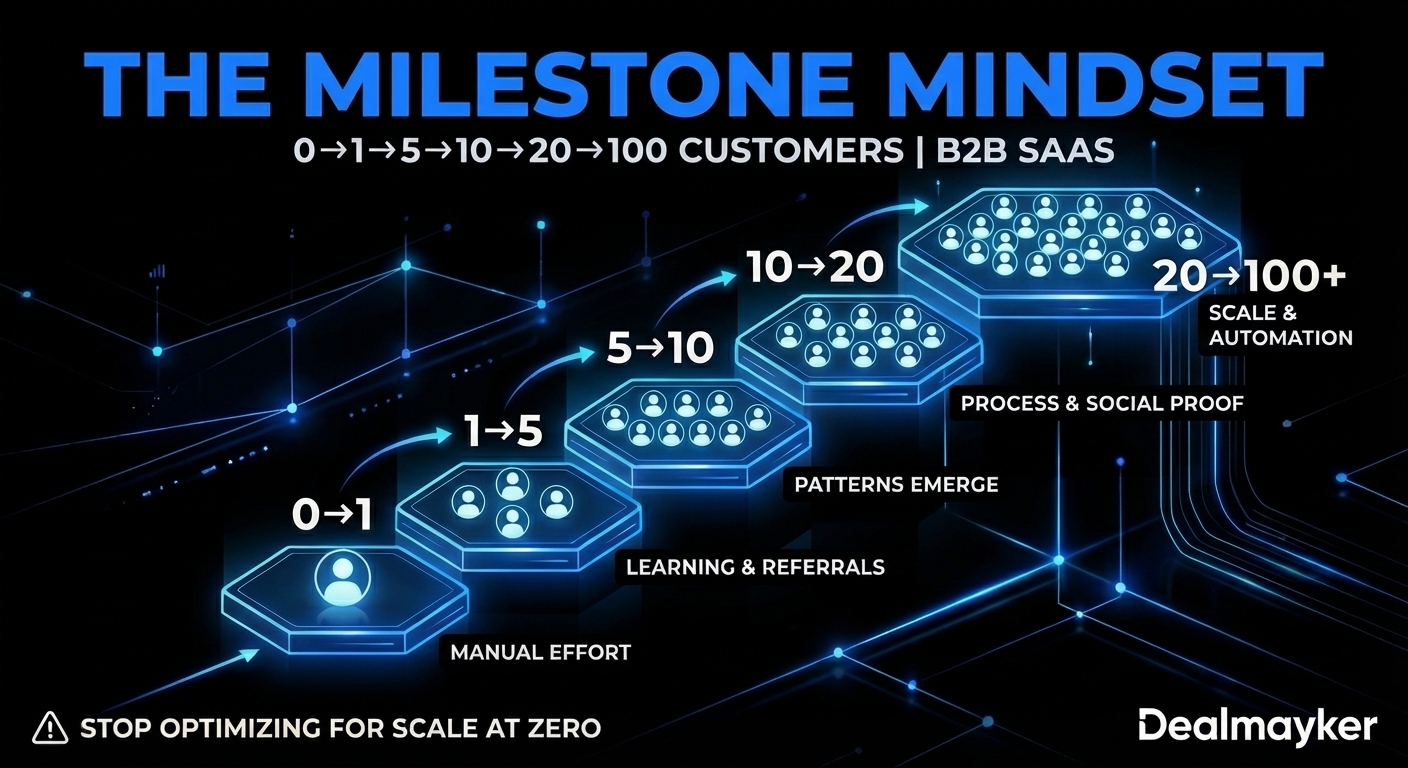
The milestone mindset: why getting from 0→1 requires a completely different strategy than 20→100, and how to avoid the fatal mistake of scaling too early
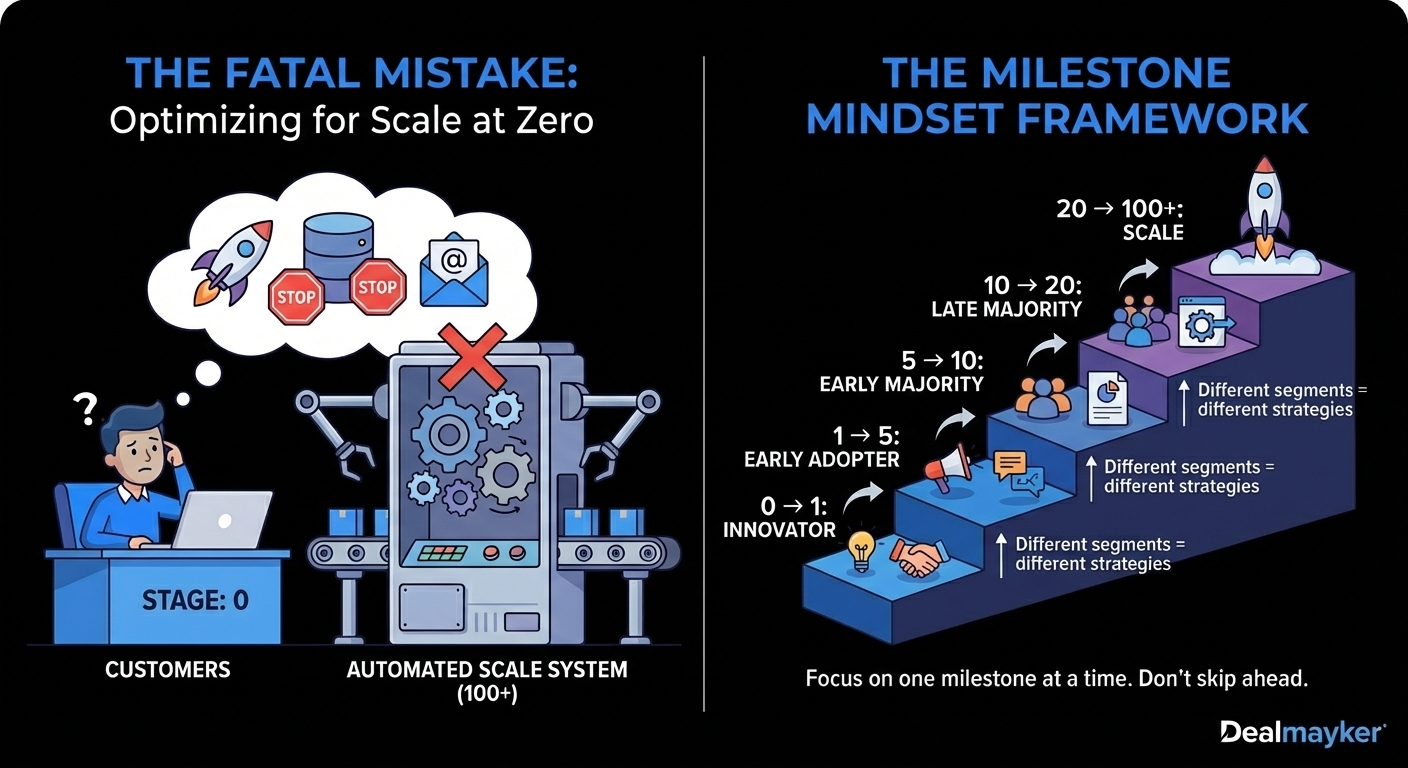
The Fatal Mistake: Optimizing for Scale at Zero
- Automated onboarding sequences
- Self-serve signup flows
- Knowledge base documentation
- Pricing tiers and packaging
- Sales playbooks and processes
The Milestone Mindset Framework
- 0 → 1 customer
- 1 → 5 customers
- 5 → 10 customers
- 10 → 20 customers
- 20 → 100 customers
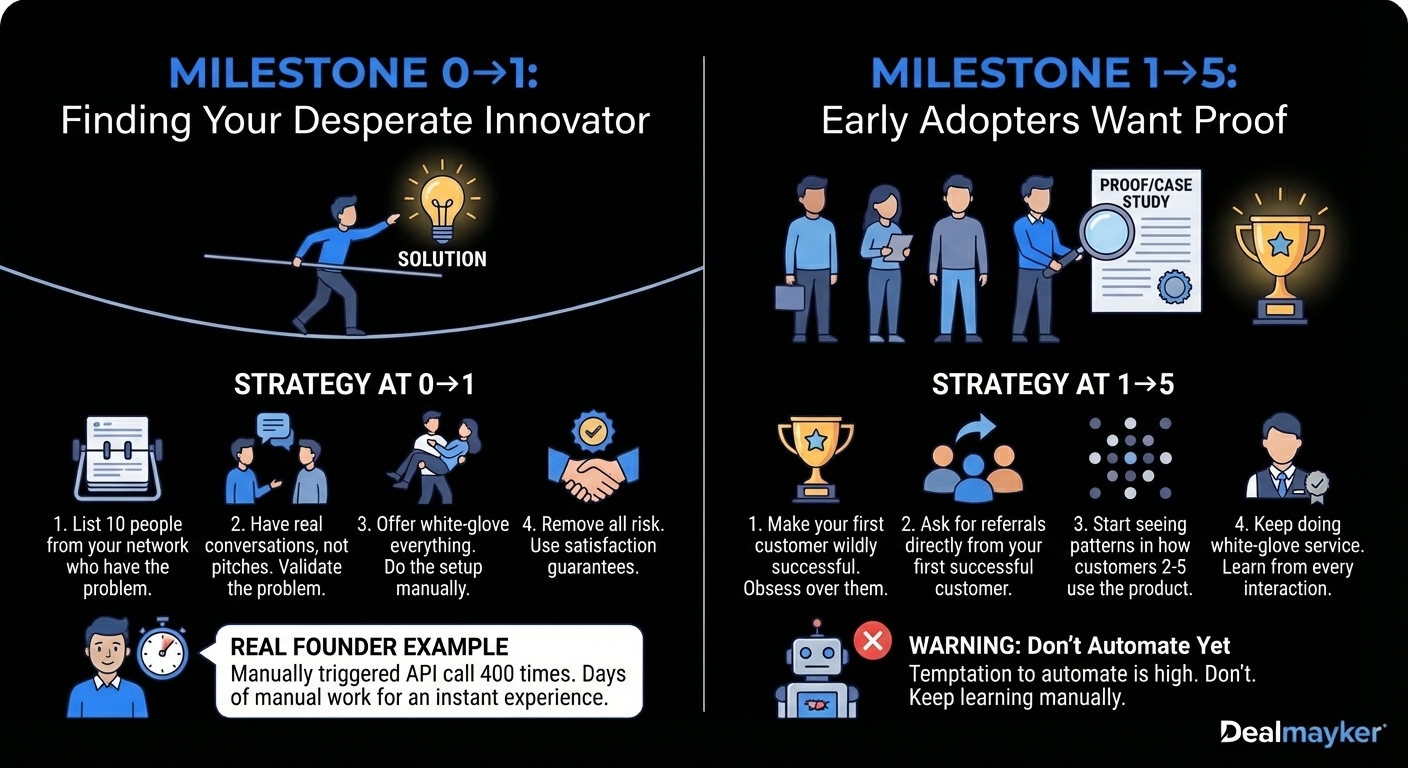
Milestone 0→1: Finding Your Desperate Innovator
- List 10 people from your network who have the problem you solve
Think friends, family, former colleagues, people from local meetups, online communities. Focus on people who genuinely have acute pain. - Have real conversations, not pitches
Ask about their current workflow. Understand their pain. Don't pitch your solution yet - just listen and validate the problem. - Offer white-glove everything
Do the setup. Handle data migration. Build workflows for them. Make it feel instant even if it takes you days in the background. - Remove all their risk
Use satisfaction guarantees: "I'll invoice you only if you're satisfied. Not happy? No invoice. No questions asked."
What success looks like: One paying customer who is actively using your product and getting value. That's it. Nothing else matters at this stage.
Milestone 1→5: Early Adopters Want Proof
- Make your first customer wildly successful
Before you even think about customer #2, obsess over customer #1. If they're paying you $20/month or $2,000/month, treat them like your only customer - because they are. - Ask for referrals directly
"Who else do you know with this problem?" If you did a good job, they'll be excited to introduce you to their friends and colleagues. - Start seeing patterns
Customer 1 might use your product one way, but customers 2, 3, 4, 5 might all use it slightly differently. Pay attention. These patterns are telling you something important about product-market fit. - Keep doing white-glove service
Yes, still. Personal onboarding for everyone. Quick responses. Learning from every interaction. Help them migrate data, import data, create workflows - whatever they need.
What success looks like: Five paying customers, all actively using your product. You're starting to see patterns in how they use it. You have at least one strong reference willing to vouch for you.
Milestone 5→10: Patterns Emerge
- Document what you're learning
By now you should be seeing clear patterns:- What do successful customers have in common?
- What questions do they all ask during onboarding?
- What workflows do they all create?
- What outcomes do they care about most?
- Start refining your ICP
You now have enough data to know who your ideal customer actually is - not who you thought it would be, but who it actually is based on real customer behavior. - Build your first case study
Document one customer's success story. Specific numbers. Specific outcomes. Specific before/after. This becomes your proof point for the next milestone. - Still doing personal onboarding
Yes, still. But now you're learning which parts can eventually be documented vs which parts need personal touch.
What success looks like: Ten customers with clear patterns emerging. You can articulate exactly who your ICP is. You have at least one detailed case study. You're starting to understand what makes customers successful vs what makes them churn.
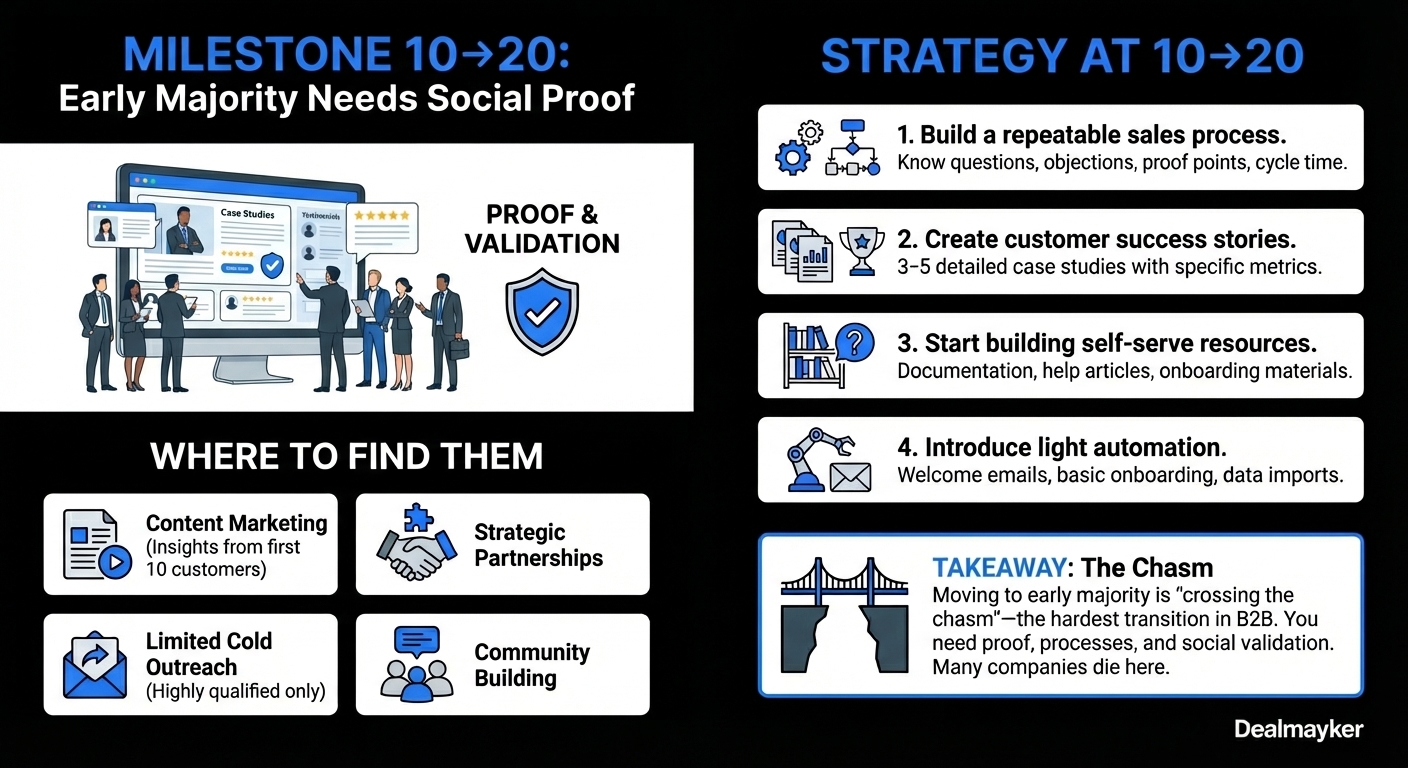
Milestone 10→20: Early Majority Needs Social Proof
- Content marketing (if you have insights from your first 10 customers)
- Strategic partnerships
- Limited cold outreach (but only to highly qualified prospects)
- Community building
- Build a repeatable sales process
By now you should know:- What questions prospects always ask
- What objections always come up
- What proof points close deals
- How long your sales cycle typically takes
- Create customer success stories
You need at least 3-5 detailed case studies with specific metrics. This is what closes early majority buyers. - Start building self-serve resources
Now - and only now - can you start creating documentation, help articles, and onboarding materials. You know what questions people ask because you've answered them 10+ times. - Introduce some light automation
Things like automated welcome emails, basic onboarding sequences, and data imports can now be partially automated - because you understand the edge cases.
What success looks like: Twenty customers. You have a repeatable (not yet scalable) sales process. Multiple case studies. Some self-serve resources. You're spending less time on each new customer because you've documented common issues.
Find prospects at the right stage
Dealmayker shows you which prospects are ready to buy now - so you can focus on the right milestone with the right customers.
Try FreeMilestone 20→100: Now You Can Think About Scale
- Paid advertising (you know your CAC and LTV)
- Content marketing at scale
- Outbound sales team
- Channel partnerships
- Product-led growth motions
- Build for scale
Now - and only now - should you be thinking about:- Fully automated onboarding
- Self-serve signup flows
- Extensive documentation
- Customer success team
- Sales playbooks and training
- Optimize unit economics
You should know:- Customer acquisition cost (CAC)
- Lifetime value (LTV)
- Payback period
- Churn rate by segment
- Segment your approach
Different customer sizes might need different approaches. Enterprise vs SMB. Self-serve vs sales-assisted. Monthly vs annual contracts. - Build the team
Now you can hire salespeople, customer success managers, and marketing people - because you have a proven playbook to train them on.
What success looks like: A hundred customers. Repeatable and scalable processes. Proven unit economics. A team executing the playbook. You're no longer personally closing every deal or onboarding every customer.
Common Mistakes at Each Milestone
- ❌ Building a perfect landing page instead of talking to people
- ❌ Launching on Product Hunt instead of reaching out to your network
- ❌ Polishing features instead of getting one person to pay you
- ✅ Have conversations with 10 people from your network
- ✅ Remove all risk with satisfaction guarantees
- ✅ Do everything manually to learn
- ❌ Starting to build automation systems
- ❌ Hiring salespeople
- ❌ Creating extensive documentation
- ✅ Obsess over making your first customer wildly successful
- ✅ Ask for referrals directly
- ✅ Keep doing white-glove service for everyone
- ❌ Thinking you have product-market fit
- ❌ Trying to scale before understanding patterns
- ❌ Building features customers haven't asked for
- ✅ Document the patterns you're seeing
- ✅ Build your first detailed case study
- ✅ Refine your ICP based on real customer data
- ❌ Still doing everything manually
- ❌ Afraid to say no to bad-fit prospects
- ❌ Not building any self-serve resources
- ✅ Create a repeatable (not scalable) sales process
- ✅ Build multiple case studies with metrics
- ✅ Start automating the obvious, repetitive tasks
- ❌ Staying too hands-on with every customer
- ❌ Not investing in team and systems
- ❌ Ignoring unit economics and metrics
- ✅ Build scalable systems and processes
- ✅ Hire and train team on your proven playbook
- ✅ Invest in channels that work for your economics
Why the Milestone Mindset Works
- It prevents premature optimization
You can't optimize what you don't understand. The milestone mindset forces you to learn before you scale. - It matches customer psychology
Different customer segments have different needs. Innovators want solutions to their desperate problems. Early majority wants proof. You can't sell to both the same way. - It keeps you focused
When you have zero customers, your only job is to get to one. Not ten. Not a hundred. One. This singular focus is incredibly powerful. - It reveals product-market fit gradually
You don't "find" product-market fit at customer #1. You discover it gradually as patterns emerge across your first 5, 10, 20 customers. - It aligns with resource constraints
As a bootstrapped founder, you can't build everything at once. The milestone mindset tells you exactly what to prioritize at each stage.
The best founders don't think about getting from 0 to 100 customers. They think about getting from 0 to 1, then 1 to 5, then 5 to 10. One milestone at a time.
Stop wasting time on the wrong prospects
Focus on prospects who match your current milestone. Get ICP matching, buying signals, and conversation starters. Start with 5 free credits.
Get Started FreeFrequently Asked Questions
What is the milestone mindset for getting B2B customers?
The milestone mindset breaks customer acquisition into stages: 0→1, 1→5, 5→10, 10→20, 20→100. Each milestone represents crossing a different customer segment (innovators, early adopters, early majority) and requires a completely different approach. It prevents you from optimizing for scale before understanding your customers.
Why shouldn't I think about automation when I have zero customers?
Because you don't know what to automate yet. You haven't learned what customers actually need, how they use your product, or what makes them successful. Building systems before this knowledge is premature optimization. Focus on manual, high-touch service so you can learn from every interaction.
What's the difference between innovators, early adopters, and early majority?
Innovators (0-1) are desperate for solutions and willing to take risks on unproven products. Early adopters (1-10) like being first but need some proof it works. Early majority (10-100+) want references, case studies, and social proof before buying. Each segment needs different messaging, proof points, and sales approaches.
When should I start building scalable systems?
After 20+ customers. Before that, focus on learning, not efficiency. At 20 customers, you should have clear patterns, a repeatable sales process, multiple case studies, and enough data to know what's worth automating. Building systems too early means you're optimizing for problems you don't understand yet.
How do I know when I've reached product-market fit?
You don't "find" it at customer #1. Product-market fit emerges gradually across your first 5-20 customers as you see patterns: similar use cases, consistent value metrics, strong retention, enthusiastic referrals, and clear ICP characteristics. If customers 2-5 use your product completely differently than customer 1, you haven't found it yet.
What should I focus on at each milestone?
0→1: Get one person to pay you through your network. 1→5: Make customer #1 wildly successful, get referrals. 5→10: Document patterns, build first case study. 10→20: Create repeatable sales process, build social proof. 20→100: Now you can think about scale, automation, and team. Each milestone has different priorities.
Why does Crossing the Chasm matter for B2B founders?
Crossing the Chasm explains why the jump from early adopters to early majority is the hardest transition. Early adopters tolerate bugs and missing features. Early majority wants proven solutions with references. Many B2B companies die in this chasm because they try to sell to early majority the same way they sold to innovators.
Should I still do white-glove service at 10 customers?
Yes, but you can start introducing light automation for obvious, repetitive tasks. You should still personally onboard customers and respond quickly, but you can begin documenting common questions, creating help articles, and automating simple workflows. Full automation comes after 20+ customers.