Stop wasting time on directories if you have 0 customers
Why directories fail on relevancy, timing, and trust - and what actually works for getting your first paying customers
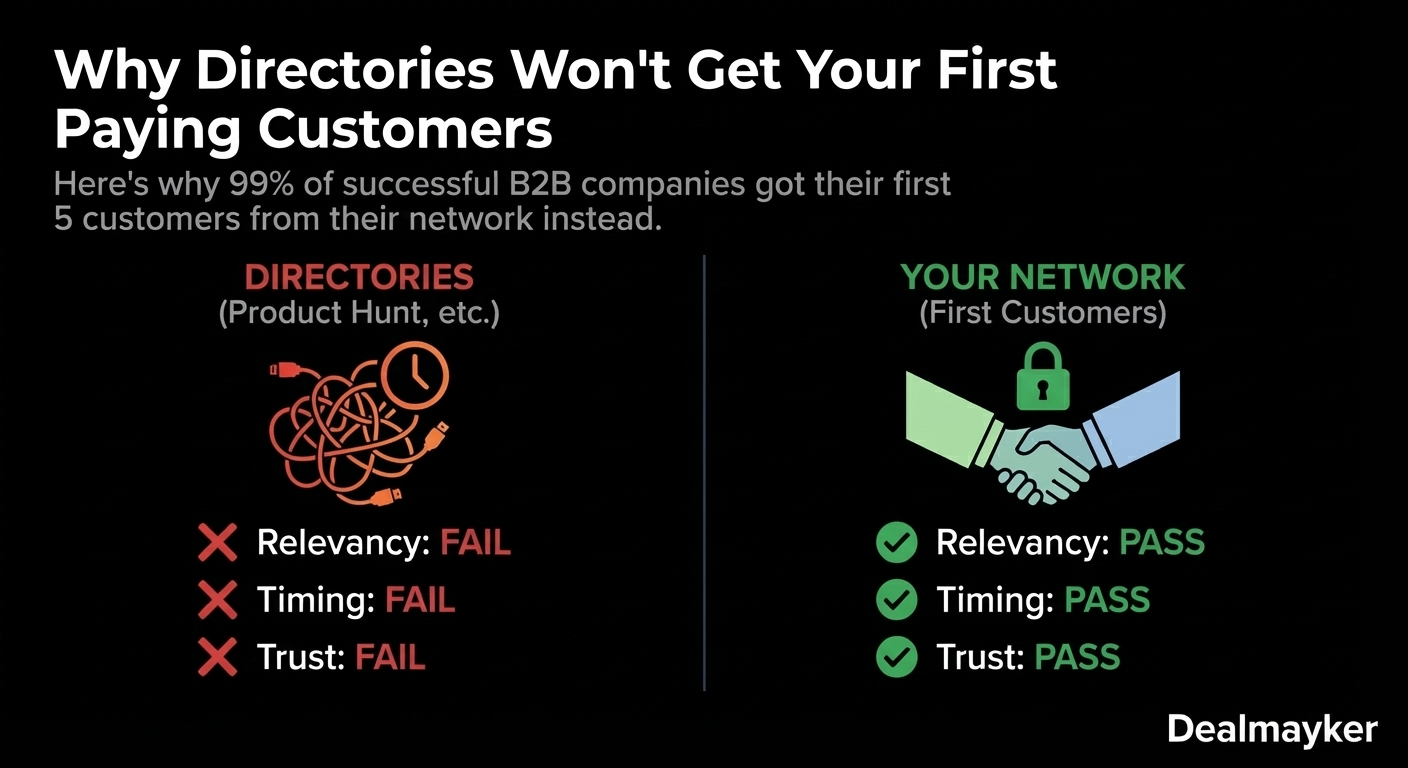
Why Directories Don't Work: The Traffic Quality Problem
But let's say you somehow get relevant traffic. Even then, you need four things to perfectly align:
- Build the right landing page for that traffic
- Nail the messaging for your audience
- Nail the design to build trust
- Convert cold traffic with zero relationship
Do you see how many things need to work for you to get even ONE demo call from a directory? It's incredibly hard when you have zero social proof.
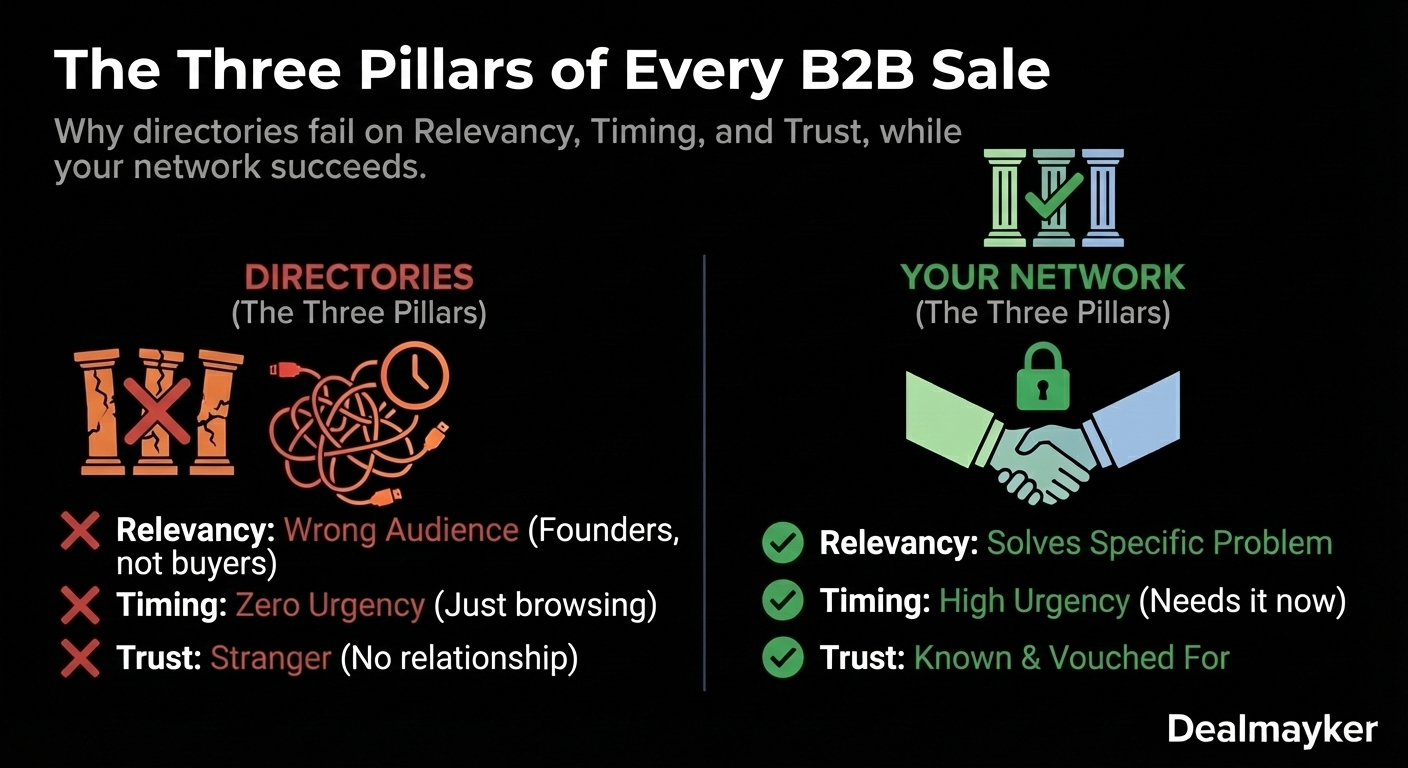
The Three Pillars Every B2B Sale Needs
- Relevancy - Your product solves their specific problem
For example, if you're a last-mile delivery company, it's unlikely that a software company would need your services. Selling to them would be pointless.
- Timing - They feel urgency RIGHT NOW
The business needs to be at the right stage to feel high importance and high urgency. A fresh e-commerce shop with zero sales has different needs than one with 100 daily sales. The first might handle delivery themselves. The second needs a scalable solution to get operations to the next level.
- Trust - They believe you'll deliver and won't disappear
Your buyers are asking themselves: Will I be satisfied with the value? Will this person disappear after payment? Are my payment details safe? There's even a saying: "Nobody was ever fired for buying a Mercedes." That's the trust element at work.
Directories fail on all three pillars:
- Relevancy: Wrong audience (founders browsing, not buyers searching)
- Timing: Zero buying urgency (just casually browsing)
- Trust: You're a stranger with a landing page
What Actually Works: Your Network
Why does this work?
Trust is your limiting factor, not reach.
Your network already knows:
- You'll pick up the phone if something breaks
- You won't disappear after they pay you
- You actually care about their success
For my first customer at my current company, I manually triggered a Postman API call 400 times - with a stopwatch timing 55-second intervals because of API rate limits. That's the level of manual, obsessive work early customers deserve, and it's only possible when there's existing trust.
Find prospects with the right timing
Dealmayker shows you who's ready to buy right now - so you can focus on building relationships with qualified prospects, not cold traffic.
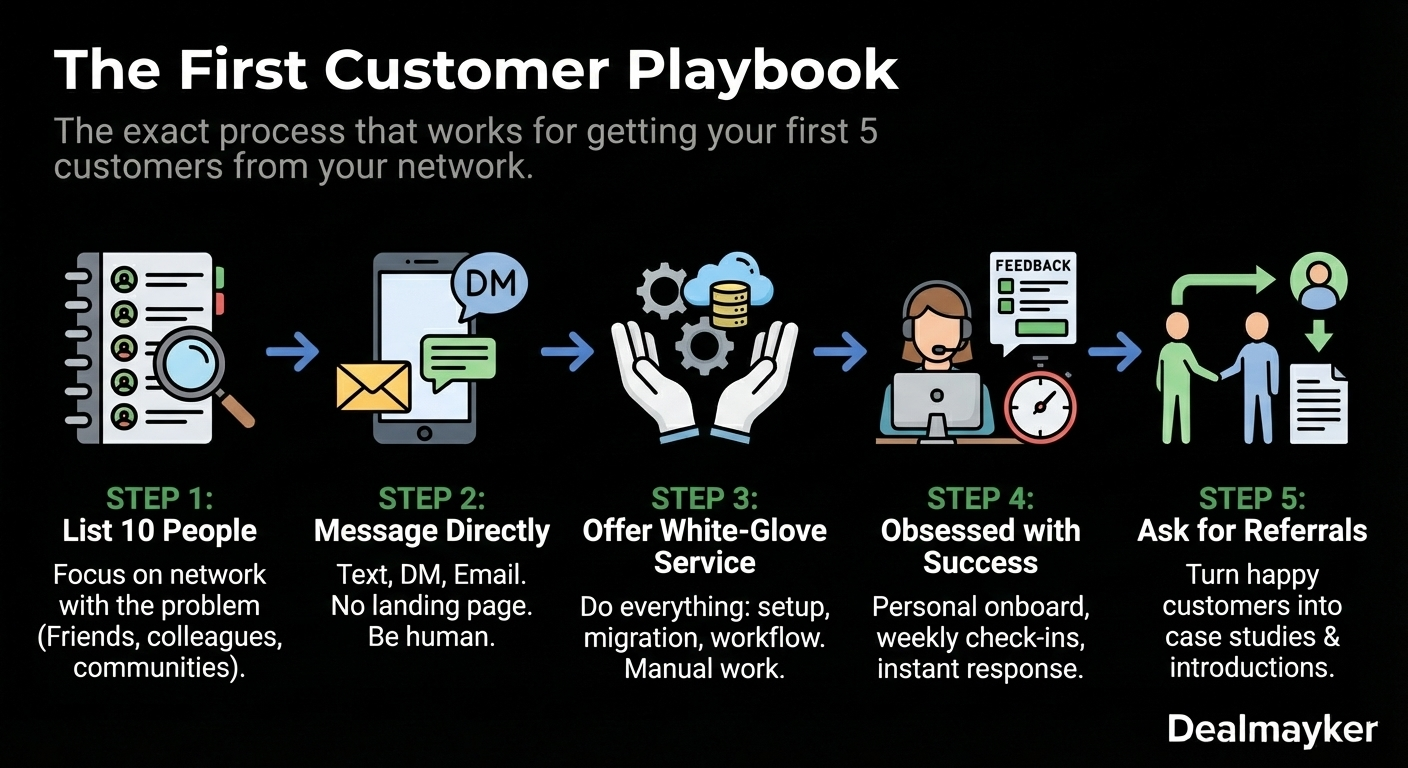
Try FreeThe First Customer Playbook
- List 10 people from your network who have the problem you solve
Think about friends, family, former colleagues, people from local meetups, online communities you're part of. Focus on people who genuinely have the pain point. - Message them directly
No fancy landing page needed. Text message, DM, email - whatever feels natural. Be human about it. - Offer white-glove service
You do everything for them: setup, data migration, workflow creation. Even if you're selling a $20/mo product. I've spent days (sometimes weeks) doing background work so the customer experience feels instant. - Get obsessed with their success
Onboard them personally. Check in weekly. Respond to questions within hours. Ask for feedback constantly. The feedback loop from your first customer is worth more than a thousand website visitors. - Ask for referrals
Once they're happy, ask them to introduce you to others who might have the same problem. Your first customer becomes your case study, your reference, your proof point.
The One Exception: Directories for Backlinks
Stop wasting time on directories
Get instant ICP matching, buying signals, and conversation starters for prospects who actually fit your business. Start with 5 free credits.
Get Started FreeFrequently Asked Questions
Should I skip directories entirely for my B2B SaaS launch?
Not necessarily skip it entirely, but don't rely on it for your first customers. Directories can give you visibility and backlinks later in your journey (after 10-20 customers), but the traffic quality rarely converts to paying B2B customers. Focus on your network first, then use directories for SEO benefits once you have traction.
What if I don't have a big network to tap into?
You have more network than you think. Start with friends, family, former colleagues, people from local meetups, and online communities you're part of. Even if your network is small, focus on second-degree connections - ask your first-degree connections to introduce you to people who have the problem you solve. Quality matters more than quantity.
How many customers should come from my network before I try other channels?
Aim for at least 5-10 customers from your network before scaling to other channels. This gives you enough feedback to refine your product, understand your ICP deeply, and build case studies. Your network customers become your proof points that help you convert strangers later.
Why does trust matter more than reach for early customers?
With zero customers and no social proof, strangers have no reason to believe you'll deliver. Your network already trusts you - they know you'll answer the phone, won't disappear after payment, and care about their success. This removes the biggest barrier to early sales. Once you have proof from network customers, reach becomes more valuable.
Can directories work for certain types of B2B products?
Directories work better for low-commitment, self-serve products with very clear use cases. But for most B2B SaaS requiring demos, relationship building, or complex sales cycles, directories rarely deliver your first paying customers. The traffic lacks relevancy, timing, and trust - the three pillars every B2B sale needs.
What's the difference between getting customer 1 vs customer 100?
Customer 1 is an innovator - someone willing to take a risk on an unproven solution because they're desperate for it to work. Customer 100 is early majority - they want references, case studies, and proof from others. Different milestones require different approaches. Focus on the milestone you're at, not the one you want to reach.