Founder Playbooks

My secret weapon for closing early customers: satisfaction guarantee

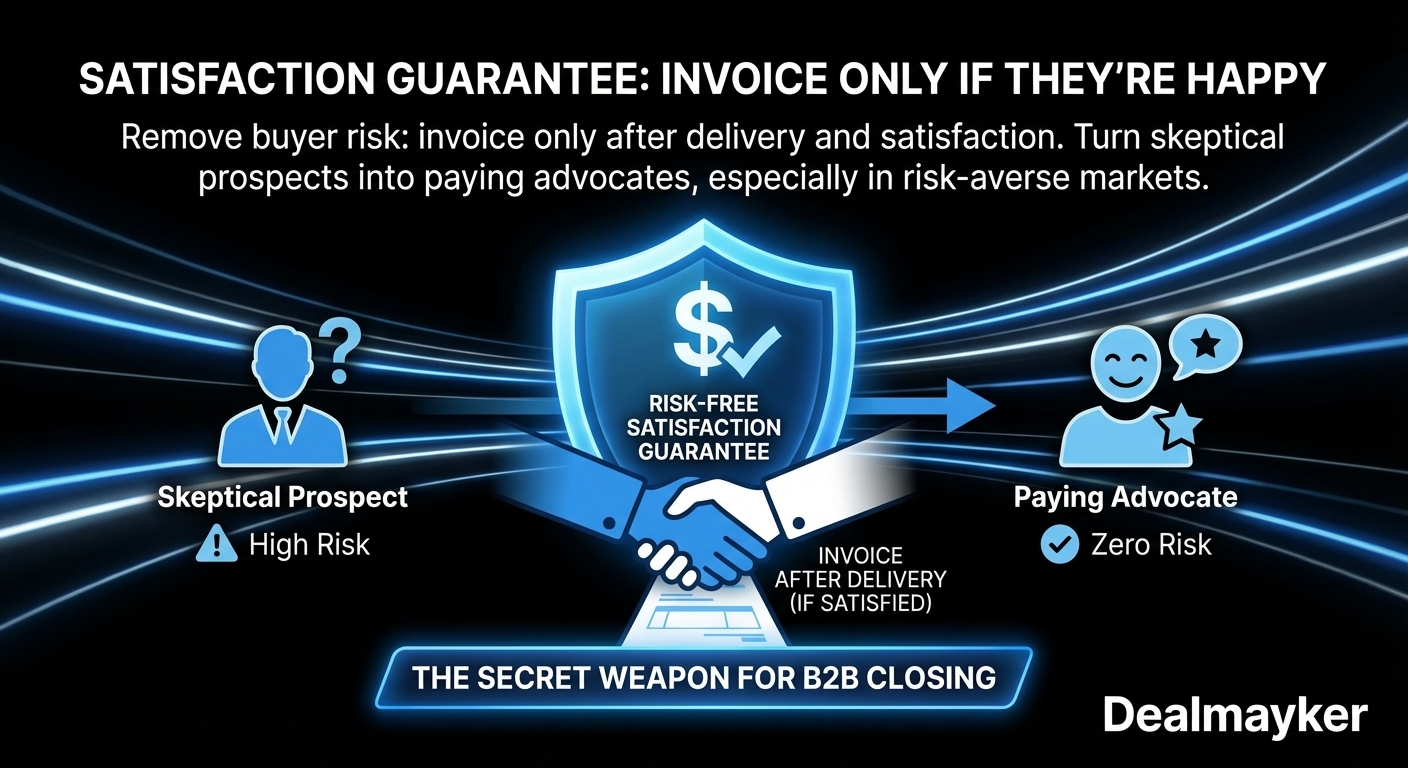
Invoice only after delivery and satisfaction. Remove all buyer risk, close skeptical prospects, and turn early customers into advocates - even in risk-averse markets.
· 13 min read
My secret weapon for closing early customers: satisfaction guarantee
I've spent 20, 30, even 40 hours on customer projects using my satisfaction guarantee. Some of those customers didn't pay - because they weren't satisfied. And that was totally fine. Because the customers who did pay? They became my biggest advocates. They referred others. They gave testimonials. They stuck around for years. The satisfaction guarantee is my secret weapon for closing early customers - especially when you have zero social proof and prospects are skeptical. Here's exactly how it works, why it's so powerful, and how to implement it without getting burned.

What Is a Satisfaction Guarantee?

A satisfaction guarantee is simple: "I'll invoice you only if you're satisfied. Not before. If you're not completely satisfied with what I delivered, I won't send you an invoice at all. No questions asked." You do the work upfront. They pay only if they're happy with the results. This flips traditional B2B sales on its head. Normally:
  • Customer pays upfront or agrees to pay
  • You deliver the product/service
  • They hope it's good
  • If it's not good, they try to get a refund (painful process)
With satisfaction guarantee:
  • You deliver the product/service upfront
  • Customer evaluates if it delivers value
  • If it delivers value, they pay happily
  • If it doesn't deliver value, no invoice (no refund needed)
The key difference: You take all the risk, not them. You're so confident in delivering value that you're willing to work for free if you don't deliver. This removes every objection and makes saying yes incredibly easy.
From the Video (15:06-15:35)
That is my secret weapon for getting early customers to say yes. I invoice them only if they are satisfied, not before. So this is for example what I've done at the previous company and the current one.
Key Takeaway : The Philosophy
A satisfaction guarantee isn't a gimmick - it's a statement of confidence. You're saying: "I'm so sure I'll deliver value that I'll work for free if I don't." That confidence is contagious and closes deals.

Why Satisfaction Guarantees Work So Well

The satisfaction guarantee works because it addresses the fundamental barrier in early-stage B2B sales: trust. When you have zero customers and zero social proof, prospects are thinking:
  • "Will this actually work for my business?"
  • "What if it doesn't deliver what they're promising?"
  • "What if they disappear after I pay?"
  • "What if I pay and my boss thinks I wasted money?"
  • "What if I look stupid for buying from an unproven company?"
Every one of these fears comes down to risk. They're risking money, time, and reputation. The satisfaction guarantee removes all of these risks:
  • Financial risk: They only pay if it works - zero financial risk
  • Time risk: You do most of the heavy lifting - minimal time risk
  • Reputation risk: If it doesn't work, they didn't waste company money - no reputation risk
  • Implementation risk: You handle setup and onboarding - no implementation risk
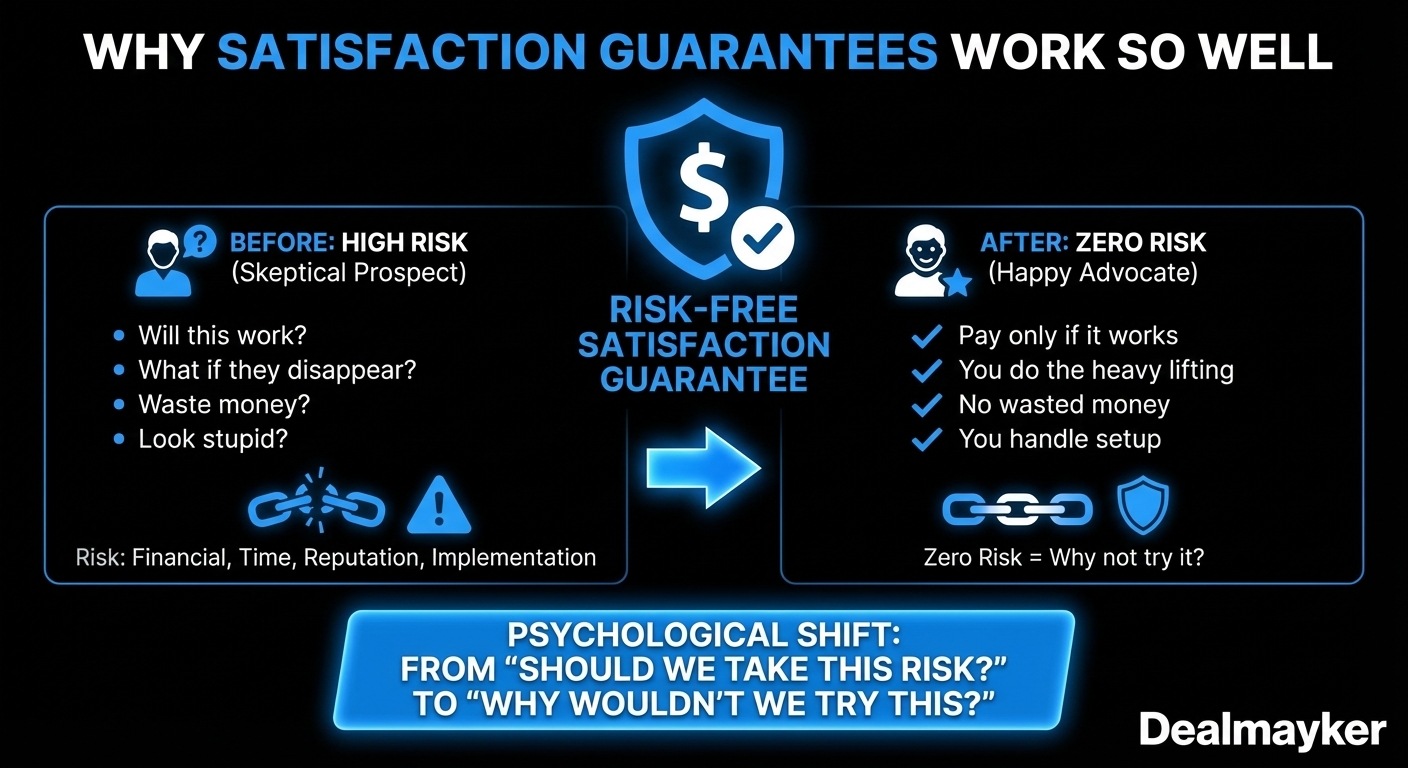
When risk goes to zero, objections disappear. The question shifts from "should we take this risk?" to "why wouldn't we try this?" Here's what happens psychologically: When someone knows they only pay if you succeed, they're much more likely to work with you in the first place. And when you're truly incentivized to make them successful (because you don't get paid otherwise), you deliver better results. Which means they actually want to pay you - and they become advocates for what you're building.
From the Video (15:53-16:22)
This removes all the risks for their side. They're not paying for a promise, they're paying for results. And if I don't deliver results, I hide the cost and I own it.
From the Video (16:48-17:18)
Here's what happens when someone knows they only pay if you succeed: they're much more likely to work with you in the first place. When you're truly incentivized to make them successful because you don't get paid otherwise, you deliver better results, which means they actually want to pay you and they become advocates for what you're building.
Example : Real Conversation
Prospect: "What if this doesn't work for us?" Me: "Then you don't pay. I only invoice if you're completely satisfied." Prospect: "Wait, so there's zero risk for us?" Me: "Zero. You only risk a bit of your time, and I'll minimize even that by doing all the setup." Prospect: "Okay, let's try it."
Why satisfaction guarantees work

How to Structure Your Satisfaction Guarantee

The satisfaction guarantee can be structured different ways depending on your business model: For beta programs / pre-product: "I'm running a [X]-month closed beta with a flat fee of [$X]. I'll set everything up for you and work closely with you to make sure it solves your problem. I'll send the invoice at the end only if you got value. Not satisfied? No charge." Key elements:
  • Defined timeframe (1-3 months typical)
  • Flat fee (simple pricing)
  • You do the setup work
  • Invoice at the end only if satisfied
For existing products with recurring billing: "Even though I have Stripe integrated for recurring payments, I have a satisfaction guarantee policy. If you pay and you're not happy, I'll refund you immediately. No questions asked. You never risk anything with us." Key elements:
  • Standard recurring billing
  • Immediate refund promise
  • No questions asked policy
  • Risk-free framing
For services / consulting / project work: "We agree on the scope and price upfront, but I'll send you the invoice only at the end of delivery. Only if you're happy. If you're not completely satisfied with what I delivered, I won't send an invoice at all." Key elements:
  • Scope agreed upfront
  • Price agreed upfront
  • Invoice sent only after delivery
  • No invoice if not satisfied
For enterprise / high-touch sales: "We'll do a 30-day pilot at no cost. I'll personally set everything up, train your team, and make sure you're getting value. After 30 days, if you're satisfied, we'll start the contract at [$X/month]. If you're not satisfied, no commitment. You owe us nothing." Key elements:
  • Free pilot period
  • White-glove setup and training
  • Value validation before payment
  • No commitment if not satisfied
The common thread across all these:
  • Customer pays only for results, not promises
  • You do heavy lifting upfront
  • Clear deliverables and timeline
  • Simple "not satisfied = no payment" policy
From the Video (15:53-16:22)
This is how it works: I agree with them on the scope and the price upfront, but I tell them: I'll send you the invoice at the end of the delivery. So only if they are happy. And I tell them: If you're not completely satisfied with what I delivered, I won't send you an invoice at all.
Tip
Always agree on scope and price upfront - even though they pay later. This prevents scope creep and sets clear expectations. They know what they're getting and what it costs. The only variable is whether you deliver enough value for them to want to pay.
How to structure satisfaction guarantees

Why This Works Especially Well in Risk-Averse Markets

The satisfaction guarantee is powerful everywhere, but it's especially effective in risk-averse markets - particularly in Europe. The European B2B buying psychology: European businesses (especially in countries like Germany, Switzerland, Netherlands, UK) tend to be more conservative and risk-averse than US businesses when it comes to:
  • Buying from unknown vendors
  • Trying new, unproven solutions
  • Being "early adopters"
  • Taking chances on startups
This isn't a weakness - it's a different business culture that values stability, proven track records, and minimizing downside risk. Traditional US startup sales tactics don't work as well:
  • "Be bold! Take a risk!"
  • "First-mover advantage!"
  • "Disrupt or die!"
  • "Move fast and break things!"
These messages don't resonate in more conservative markets. They actually increase objections. The satisfaction guarantee speaks directly to risk-averse buyers: You're not asking them to "take a risk" or "be bold." You're saying: "There is zero risk. I take all the risk. You only proceed if it works for you." This aligns perfectly with their buying psychology. It removes the thing they care about most: downside risk. My experience with European customers: This approach helped me tremendously getting European customers committed to pre-product sales and beta programs. The satisfaction guarantee policy made them comfortable trying something new from an unproven founder. They weren't "taking a chance on a startup." They were "evaluating a solution with zero downside risk." That reframing changes everything.
From the Video (16:23-16:48)
And this is particularly important in regions like Europe where risk aversion is quite high towards new things. So this helped me a lot getting European customers committing to the pre-product sales or pre-selling to them.
Example : German Customer Story
A German prospect kept saying "we need to see proven results from other companies first." I offered the satisfaction guarantee: "You'll be our proof. If it works, you pay and become a reference. If it doesn't work, you invested nothing but time." They said yes immediately. They became one of our strongest advocates.
Key Takeaway : Cultural Adaptation
The same sales tactic (satisfaction guarantee) works everywhere, but it's 3-5x more powerful in risk-averse markets. If you're selling internationally, lead with this - especially in Northern/Central Europe.

The Reality: Some Customers Won't Pay

Let's address the elephant in the room: Some customers won't pay. I've done 20, 30, even 40-hour projects where customers weren't satisfied and didn't pay. That's just the reality of a true satisfaction guarantee. Here's what actually happens: Out of every 10 customers you work with using satisfaction guarantee:
  • 7-8 will be satisfied and pay happily (they got value)
  • 1-2 will be satisfied and pay hesitantly (they got some value but not overwhelming)
  • 0-1 won't be satisfied and won't pay (you didn't deliver enough value for their situation)
That 0-1 who doesn't pay? That's not a failure - it's valuable data. They teach you:
  • What doesn't work about your product/service
  • What edge cases you didn't consider
  • What types of customers aren't a good fit
  • What you need to fix or improve
The math still works strongly in your favor: Let's say you spend 40 hours on a customer project priced at $2,000.
  • Without satisfaction guarantee: Close rate 20-30%, so you might close 2-3 out of 10 prospects = $4,000-$6,000 revenue
  • With satisfaction guarantee: Close rate 60-80%, and 8-9 out of 10 pay = $16,000-$18,000 revenue
Even if 1-2 customers don't pay (costing you 40-80 hours of work), you still come out way ahead because your close rate is 3x higher. Plus, the customers who do pay become advocates: They refer others because you proved you deliver. They give testimonials. They become case studies. They renew and expand. The lifetime value of a satisfied customer who started with a satisfaction guarantee is often 2-3x higher than a regular customer - because the trust is deeper.
From the Video (16:23-16:48)
I've done this also with the customers where I spent 20, 30, even 40 hours on their project. If they're not happy, I don't get paid. But here's what happens when someone knows they only pay if you succeed, they're much more likely to work with you in the first place.
Common Mistake : Don't Abuse the Guarantee
If more than 20-30% of your customers aren't paying, you have a delivery problem, not a pricing problem. The guarantee reveals whether you're actually creating value. If most people aren't satisfied, fix your product before continuing.
Example : A 40-Hour Project That Didn't Pay
I spent 40 hours on a customer project. They weren't satisfied - my solution didn't fit their workflow as well as I thought. I didn't invoice them. But I learned they needed a different approach, which I built into the product. The next 5 customers with similar profiles were all satisfied and paid because I fixed what I learned from the non-payer.
Satisfaction guarantee results

How to Minimize Non-Payments While Keeping the Guarantee

You want to honor your satisfaction guarantee genuinely, but you also want to maximize the percentage of customers who are satisfied and pay. Here's how to do both: 1. Qualify prospects harder upfront Don't offer satisfaction guarantee to everyone. Offer it to prospects who:
  • Have clear, urgent problems you can solve
  • Are in your ideal customer profile
  • Have realistic expectations about what you can deliver
  • Are willing to work with you collaboratively
Red flags to avoid:
  • Vague or constantly changing requirements
  • Unrealistic expectations ("can this solve everything?")
  • Poor communication or unresponsiveness
  • History of being unsatisfied with every vendor
2. Set crystal-clear scope and deliverables upfront Before starting any work, document:
  • Exactly what you'll deliver
  • Exactly what success looks like
  • Specific timeline and milestones
  • What's included vs what's not included
Get them to agree to this scope. This prevents "I thought you'd do X" surprises at the end. 3. Involve them throughout the process Don't disappear for 4 weeks and then deliver. Check in regularly:
  • Week 1: "Here's what we're building first, does this match your vision?"
  • Week 2: "Here's progress, want to see a demo?"
  • Week 3: "We're refining based on your feedback"
  • Week 4: "Final delivery, let's review together"
This prevents them from being surprised or disappointed at the end. 4. Under-promise and over-deliver Set expectations slightly lower than what you think you can deliver. Then exceed them. If you think you can deliver by Friday, promise Monday. If you think you can include 5 features, promise 3 and deliver 5. This makes "satisfaction" much easier to achieve. 5. Ask "are you satisfied?" explicitly At the end of delivery, have a direct conversation: "We agreed on [scope]. I delivered [what you delivered]. Are you satisfied with this? Does this solve your problem?" Don't just assume. Get explicit confirmation. If they say "mostly satisfied but...," ask: "What would make you completely satisfied?" Then decide if you can deliver that quickly. 6. Make it easy to be satisfied Do white-glove service:
  • Handle all setup and configuration
  • Migrate their data
  • Build initial workflows
  • Train their team
  • Be available for questions
The more you do for them, the more likely they'll be satisfied.
Tip
The satisfaction guarantee works best when paired with white-glove service. You're not just saying "pay only if satisfied" - you're saying "I'll do everything possible to ensure you're satisfied." That combination is unstoppable.
From the Video (17:18-17:45)
The goal is for early sales, for pre-selling, for beta programs to reduce their risk to zero. Basically that they don't have much of a risk besides a little bit of their time and the more things you do for them as mentioned before like migration, importing data, creating data for them, creating workflows so they don't need to do it themselves.

When to Use (and Not Use) Satisfaction Guarantees

Satisfaction guarantees aren't right for every situation. Here's when to use them: ✅ Use satisfaction guarantees when:
  • You have zero social proof: First 5-20 customers, no case studies yet
  • Prospect is skeptical: They're interested but hesitant due to risk
  • You're selling in risk-averse markets: Europe, enterprise, regulated industries
  • You're pre-selling: Product doesn't exist yet, validating demand
  • High-value, high-touch deals: Where your personal involvement ensures success
  • You're confident you can deliver: You know you can create value for this customer
❌ Don't use satisfaction guarantees when:
  • You have strong social proof: 100+ customers, tons of case studies, known brand
  • You're selling low-touch, self-serve: Can't control their experience enough
  • Customer is clearly not a fit: They don't have the problem you solve
  • You're not confident you can deliver: If you think it might not work, don't offer the guarantee
  • Customer has unrealistic expectations: They want magic, not a realistic solution
  • You're at scale: Once you have 50+ customers, you need the guarantee less
The transition away from satisfaction guarantees: As you grow, you'll naturally use satisfaction guarantees less:
  • Customers 1-10: Almost always offer it
  • Customers 10-30: Offer it for skeptical prospects or new segments
  • Customers 30-50: Offer it occasionally for strategic deals
  • Customers 50+: Rarely offer it - your social proof does the work
Once you have enough case studies, testimonials, and brand recognition, you don't need to take all the risk anymore. The guarantee becomes less critical as trust is easier to establish.
Key Takeaway : Satisfaction Guarantee = Early-Stage Secret Weapon
Think of satisfaction guarantees as training wheels for your business. You need them when you're learning to ride (no social proof). Once you're steady (strong social proof), you don't need them anymore. But they're critical for getting started.
Tip
Even after you have social proof, keep the satisfaction guarantee in your back pocket for strategic situations: enterprise deals, new market entry, or high-value skeptical prospects. It's a powerful close-accelerator when you need it.

Find prospects worth the guarantee

Dealmayker identifies high-fit prospects with strong buying signals - the customers most likely to be satisfied and become advocates.

Try Free

How to Present the Satisfaction Guarantee

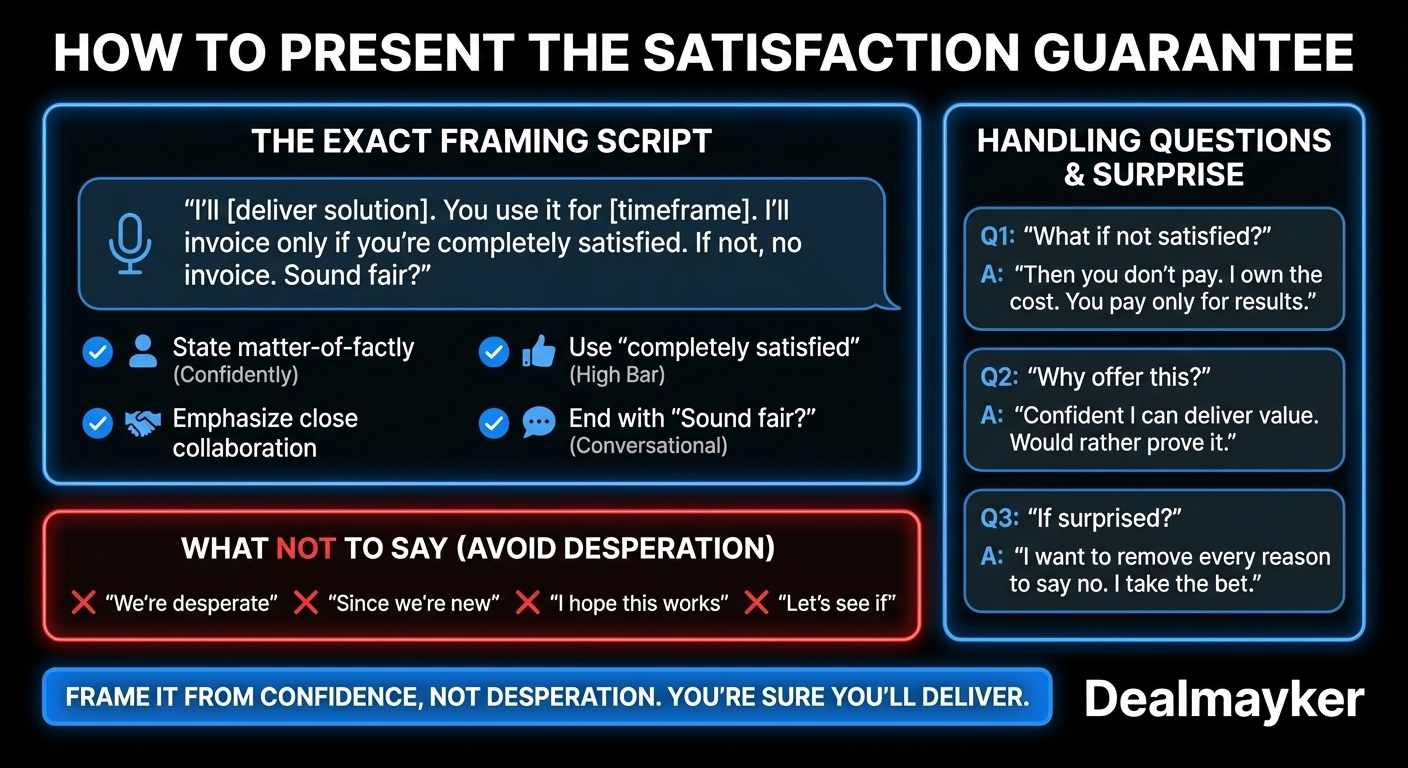
The way you present the satisfaction guarantee matters. Here's the exact framing I use: During the sales conversation (after confirming fit): "So it sounds like this is exactly what you need to solve [problem]. Here's how we'll work together: I'll [do all the setup/build the solution/deliver the beta]. You'll use it for [timeframe] while I work closely with you to make sure it's solving your problem. At the end of [timeframe], I'll send you an invoice only if you're completely satisfied. If you're not happy with the value you got, I won't send an invoice at all. No questions asked. Sound fair?" Key elements of this framing:
  • State it matter-of-factly: Not as a "special offer" or desperate move, just how you work
  • Emphasize you'll work closely with them: You're not just delivering and hoping - you're invested in their success
  • Use "completely satisfied" not "satisfied": Sets a high bar, shows confidence
  • End with "sound fair?": Makes it conversational, not a sales pitch
If they ask "what if we're not satisfied?": "Then you don't pay. Simple as that. I own the cost and the time. You only pay for results." If they ask "why do you offer this?": "Because I'm confident I can deliver value for your situation. And I'd rather prove it than just say it." If they seem surprised: "Look, I know you're taking a chance on [us/me/this solution]. I want to remove every reason for you to say no. The only risk here is my time - and I'm willing to take that bet because I'm confident this will work for you." What NOT to say:
  • ❌ "We're so desperate for customers we'll do anything"
  • ❌ "Since we're new, we have to offer this"
  • ❌ "I hope this works for you"
  • ❌ "Let's see if this works"
Frame it from confidence, not desperation. You're offering it because you're sure you'll deliver, not because you're begging for customers.
Example : Real Conversation
Me: "I'll set everything up for you. You'll use it for 2 months. I'll only invoice if you're completely satisfied." Them: "What if we're not satisfied?" Me: "Then you don't pay. I own the cost. You only pay for results." Them: "That's... really fair. Okay, let's do it."
Tip
Present the satisfaction guarantee as a natural part of your process, not a special concession. "This is how I work with early customers" sounds confident. "I'll make an exception for you" sounds desperate.
How to present satisfaction guarantees

Satisfaction Guarantees Turn Skeptics Into Advocates

The most powerful outcome of satisfaction guarantees isn't just closing more deals - it's the type of customers you create. When someone starts as a skeptic but you deliver: They don't just become a paying customer. They become an advocate. Why? Because you proved them wrong in the best way possible. They were skeptical. You removed all their risk. You delivered exceptional value. You exceeded their expectations. They feel like they discovered a gem. These advocates become your growth engine:
  • They give enthusiastic testimonials: "I was skeptical, but they delivered. Zero risk, huge value."
  • They refer others proactively: "You have to try this - there's no risk, and it actually works."
  • They become case studies: Their story is: skeptic → satisfied customer → advocate
  • They expand and renew: High retention because you proved trustworthiness early
  • They defend you publicly: When someone questions your company, they speak up
This is the magic of the satisfaction guarantee: You're not just getting a customer - you're getting proof that you deliver. And that customer becomes living proof for the next 10 customers. The compound effect:
  • Customer 1: Skeptic, takes a chance on satisfaction guarantee, becomes advocate
  • Customer 2-3: Referred by Customer 1, already trusts you, easier close
  • Customer 4-6: See testimonial from Customer 1, social proof established
  • Customer 7-10: You have multiple advocates, no longer need guarantee as much
The satisfaction guarantee is your bridge from "nobody knows us" to "people vouch for us." It's not just a closing tactic - it's a trust-building and advocacy-creation engine.
From the Video (16:48-17:18)
When you're truly incentivized to make them successful because you don't get paid otherwise, you deliver better results, which means they actually want to pay you and they become advocates for what you're building.
Example : From Skeptic to Advocate
One customer told me upfront: "I've tried 3 tools like yours and none worked." I offered the satisfaction guarantee. After delivery, he was thrilled. He became my strongest advocate - referred 4 customers, gave a detailed testimonial, and spoke at a conference about our solution. All because we removed his risk and over-delivered.
Key Takeaway : The ROI of Advocates
A satisfied customer who started skeptical is worth 3-5x more than a customer who was eager from day one. They refer more, they stick around longer, they give better testimonials, and they defend you publicly. The satisfaction guarantee identifies and converts these high-value advocates.
The satisfaction guarantee is my secret weapon for closing early customers. "I'll invoice you only if you're satisfied. Not happy? No invoice. No questions asked." This single sentence removes every objection:
  • Financial risk → Zero (pay only if satisfied)
  • Time risk → Minimal (you do the heavy lifting)
  • Reputation risk → Zero (no wasted money if it doesn't work)
  • Implementation risk → Zero (you handle setup)
Why it works:
  • Closes skeptical prospects who would otherwise say no
  • Especially powerful in risk-averse markets (Europe, enterprise)
  • Forces you to deliver exceptional value (or you don't get paid)
  • Turns early customers into advocates (they become your proof)
  • Increases close rate 3-5x for early-stage companies
The reality:
  • 80-90% of customers will be satisfied and pay happily
  • 10-20% won't pay, but they teach you what to fix
  • Your revenue is still 3x higher than without the guarantee
  • The customers who pay become your strongest advocates
How to implement it: This week: Add satisfaction guarantee language to your sales conversations Script: "I'll [deliver X]. You'll use it for [timeframe]. I'll invoice only if you're completely satisfied. Not happy? No invoice. Sound fair?" Next 5 prospects: Offer this to everyone who's interested but hesitant Track: How many say yes with the guarantee vs without it You'll see your close rate jump immediately. And you'll start building a roster of advocates who prove you deliver. The satisfaction guarantee isn't about tricking people - it's about removing barriers. You're saying: "I'm so confident I'll create value for you that I'll work for free if I don't." That confidence is contagious. It closes deals. It builds trust. It creates advocates. And it's how you go from zero social proof to a growing list of customers who vouch for you. Use it. It works.

Close more skeptical prospects

Get ICP matching and deal-readiness signals to identify prospects who are good fits - making satisfaction guarantees even more effective. Start with 5 free credits.

Get Started Free

Frequently Asked Questions

What is a satisfaction guarantee in B2B sales?

A satisfaction guarantee means you invoice the customer only after delivery and only if they're satisfied. If they're not happy with the value delivered, you don't send an invoice at all. No questions asked. You do the work upfront, and they pay only if it delivers results. This removes all financial risk from the buyer's side - you take the risk instead.

Why do satisfaction guarantees work so well for early-stage companies?

When you have zero social proof, prospects are thinking: "Will this work? What if they disappear? What if I waste money?" The satisfaction guarantee removes all these risks. Financial risk = zero (pay only if satisfied). Reputation risk = zero (no wasted money if it doesn't work). When risk goes to zero, objections disappear. Close rates jump 3-5x because saying yes becomes incredibly easy.

Won't customers just not pay even if I deliver?

Reality: 80-90% of customers will be satisfied and pay happily if you deliver value. 10-20% won't pay, but they teach you what to fix. The math still works in your favor - your close rate is 3x higher with the guarantee, so you make more revenue overall even with some non-payments. Plus, customers who pay become advocates because you proved you deliver.

Why does this work especially well in Europe?

European businesses tend to be more risk-averse than US businesses - they value stability, proven track records, and minimizing downside. Traditional "take a risk" messaging doesn't resonate. The satisfaction guarantee speaks directly to this psychology: "There is zero risk. I take all the risk. You only proceed if it works." This aligns perfectly with risk-averse buying behavior and dramatically increases conversion.

How do I structure a satisfaction guarantee?

Key elements: (1) Agree on scope and price upfront, (2) You deliver/do setup first, (3) Customer evaluates if it delivers value, (4) Invoice sent only if satisfied, (5) No invoice if not satisfied - no questions asked. Example: "I'll set everything up. You'll use it for 2 months. I'll invoice only if you're completely satisfied. Not happy? No charge." Simple, clear, removes all risk.

When should I use (and not use) satisfaction guarantees?

Use when: you have zero social proof (first 5-20 customers), prospect is skeptical, selling in risk-averse markets, pre-selling, high-touch deals where you control the experience. Don't use when: you have strong social proof (100+ customers), low-touch/self-serve product, customer isn't a fit, you're not confident you can deliver. The guarantee is for early-stage trust building, not needed once you have social proof.

How do I minimize non-payments while keeping the guarantee?

Six tactics: (1) Qualify harder upfront - only work with good-fit prospects, (2) Set crystal-clear scope and deliverables before starting, (3) Involve them throughout delivery - no surprises at the end, (4) Under-promise and over-deliver, (5) Ask "are you satisfied?" explicitly at the end, (6) Do white-glove service - make it easy to be satisfied by doing all setup, migration, and training for them.

What makes satisfied customers become advocates?

When someone starts as a skeptic, you remove their risk, then over-deliver - they become an advocate because you proved them wrong in the best way. They feel like they discovered a gem. These advocates give enthusiastic testimonials, refer others proactively, become case studies, expand/renew at high rates, and defend you publicly. A skeptic-turned-advocate is worth 3-5x more than an eager buyer because they're more vocal and loyal.

Aleksa

Aleksa

Founder of Dealmayker

I'm Aleksa, founder of Dealmayker (bootstrapping it solo), building the future of B2B sales through contextual & emotional intelligence. On the journey to be a 1-person unicorn. Previously built Hyperaktiv and worked in B2B sales at SaaS & FinTech companies.