Get paid before you build
Two proven pre-selling tactics to validate your B2B SaaS: clickable prototype demos and text-message beta invites. Get committed customers before writing production code.
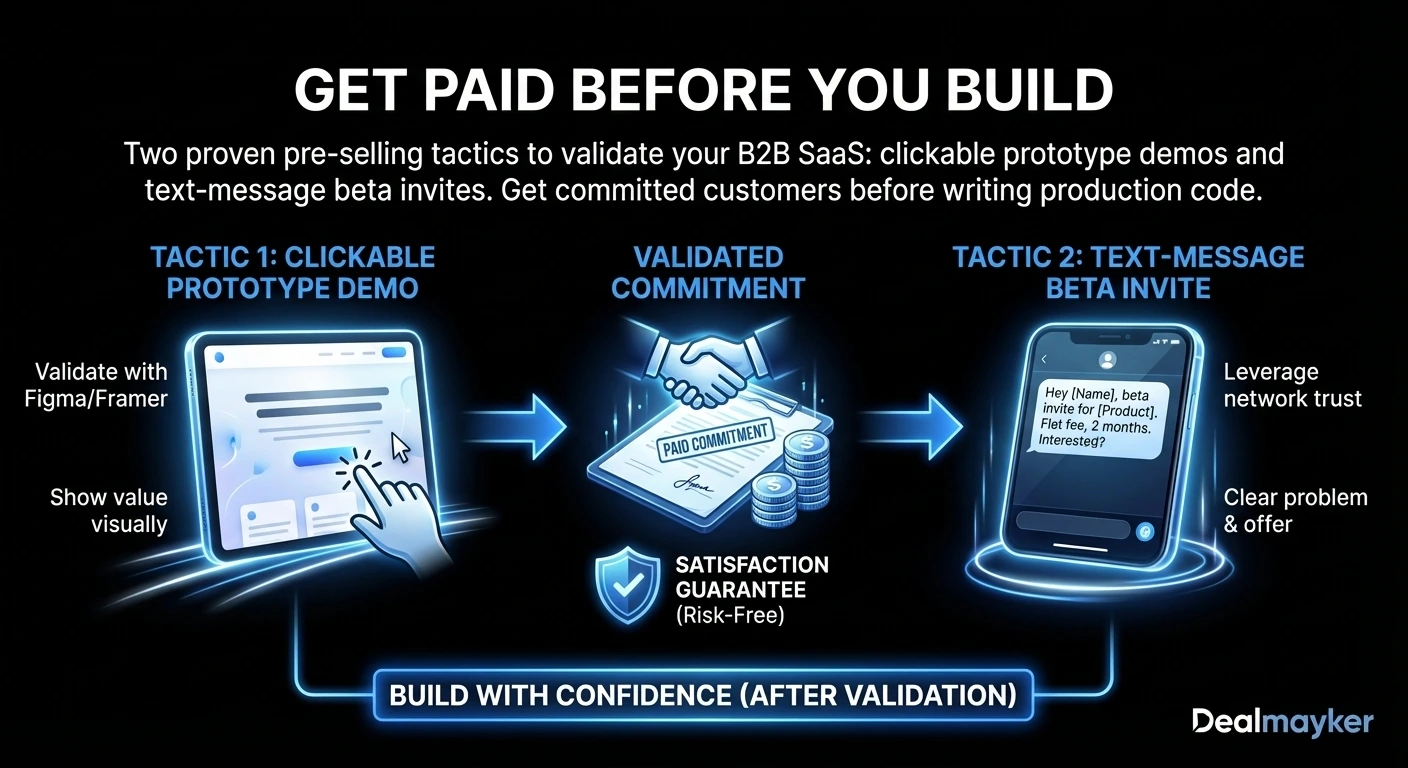
Why Pre-Selling Beats Building First
- Step 1: Have an idea for a product
- Step 2: Spend 3-6 months building it
- Step 3: Launch and try to find customers
- Step 4: Realize nobody wants it (or not enough people want it)
This is backwards.
The pre-selling approach flips this:
- Step 1: Have an idea for a product
- Step 2: Validate if people will actually pay for it (before building)
- Step 3: Get paid commitments from 3-5 customers
- Step 4: Build only what those paying customers need
- Step 5: Deliver to customers who already committed to pay
Why this works better:
- Validates real demand: People say yes to free products all the time. Pre-selling validates they'll actually pay.
- Reduces waste: You only build features customers actually need, not features you think they need.
- Provides cash flow: You get money upfront (or committed) to fund development.
- Creates accountability: Paying customers give you deadline pressure and clear requirements.
- Builds confidence: Knowing people will pay makes it easier to commit to building.
The best part? You don't need a finished product to pre-sell. You just need to demonstrate the value convincingly.
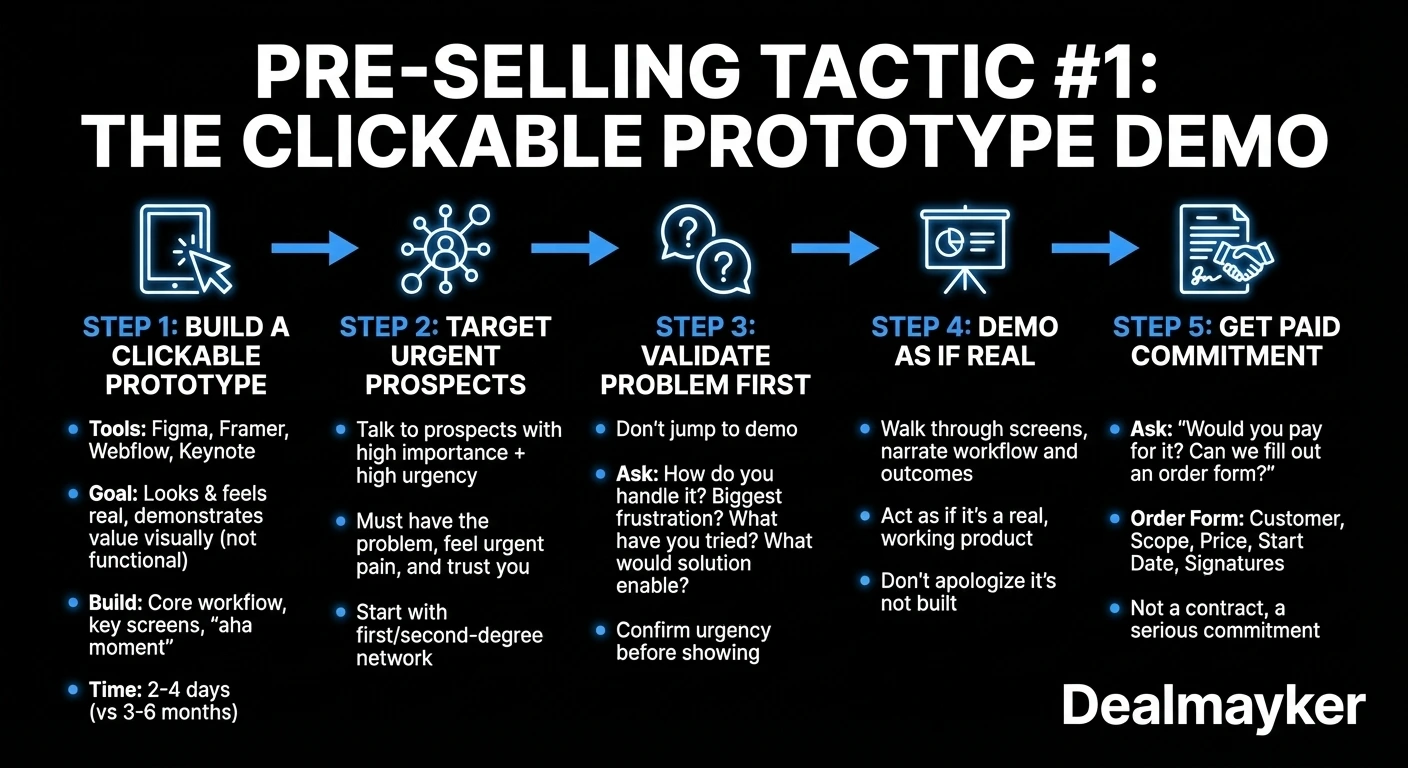
Pre-Selling Tactic #1: The Clickable Prototype Demo
- Build a clickable prototype (not a real product)
Use tools like:- Figma: Best for clean, professional-looking prototypes
- Framer: Good for more interactive prototypes
- Webflow: If you want something that looks like a real web app
- PowerPoint/Keynote: Even these work if you make them clickable
The goal: create something that looks and feels like the real product when you click through it. It doesn't have to work - it just has to demonstrate the value visually.
How much to build:
- The core workflow (the main thing your product does)
- Key screens showing input → processing → output
- Just enough to demonstrate the "aha moment"
- Don't build every feature - focus on the core value proposition
Time investment: 2-4 days to build a compelling prototype (vs 3-6 months for a real product)
- Get meetings with prospects who have high importance + high urgency
This tactic only works if you're talking to people who:- Have the problem you're solving (relevancy)
- Feel urgent pain right now (timing)
- Trust you enough to take a meeting (trust)
Start with your network. These should be first or second-degree connections who you know have the problem.
- During the meeting, first validate the problem
Don't jump straight to showing the prototype. Start by asking questions:- "Tell me about how you currently handle [problem]?"
- "What's the biggest frustration with your current approach?"
- "What have you tried so far?"
- "If this problem were solved, what would that enable for you?"
Only show the prototype after you've confirmed they have high importance and high urgency for the solution.
- Demo the prototype as if it's real
Walk them through the prototype clicking through screens. Narrate what it does:
"So when you log in, you'd see all your [data] here. Then you click this button, and it automatically [does the thing]. And here's where you'd see the results - specifically [outcome they care about]."
Act as if this is a real, working product. Don't apologize that it's not built yet.
- Ask for commitment right there
After showing the prototype:
"This can solve the exact problem you just described. Would you like to be one of the first to use this? Would you pay for it?"
If they say yes:
"Great! Let's fill out an order form right now with a specific start date, scope, and price. Once we deliver, you'll start paying [amount]."
The order form should include:
- Customer name and company
- Specific scope (what you'll deliver)
- Price (monthly or one-time)
- Start date (when they'll get access)
- Both signatures
This isn't a contract that forces them to pay - it's a commitment that shows they're serious.
Why the Clickable Prototype Works So Well
- What exactly does this product do?
- What's the core workflow?
- What's the "aha moment" that makes them see value?
- What's the simplest version that demonstrates value?
- What screens do they lean forward for?
- What questions do they ask?
- What features do they assume exist?
- What confuses them?
Pre-Selling Tactic #2: The Text-Message Beta Invite
- Compile a shortlist of people you know have the problem
Make a list of 10-20 people from your network (first or second-degree connections) who:- Have the problem you're solving
- Are in a position to make buying decisions
- Trust you enough to read a message from you
- Would benefit from solving this problem
Quality over quantity. You don't need 100 people - you need 10-20 highly qualified people who actually have the pain.
- Write a detailed text message or DM
The message should include:
- What you're building (1-2 sentences)
"I'm building [product] that helps [target audience] solve [specific problem]." - The problem it solves (2-3 sentences)
"Right now, when you need to [do X], you have to [current painful process]. This means [negative outcome]. [Product] automates this by [how it works]." - What the outcome looks like (1-2 sentences)
"Instead of spending [time] on [task], you'll get [outcome] in [shorter time]." - The beta offer (2-3 sentences)
"I'm running a 2-month closed beta with a flat fee of [price]. You'll get early access and direct input into the product. Do you want to participate?"
Keep it conversational, not salesy. You're not pitching - you're inviting them to solve a problem they have.
- What you're building (1-2 sentences)
- Send to your shortlist (not as a blast, individually)
Don't mass-send this. Send it individually to each person, ideally with a personalized first line:
"Hey [Name], hope you're doing well! Quick question - are you still dealing with [problem] at [Company]? I remember you mentioning it."
Then paste your beta invite message.
- Have follow-up conversations with people who respond
When someone replies with interest:- Jump on a quick call to understand their specific situation
- Confirm they have high urgency (not just mild interest)
- Walk them through exactly what they'll get in the beta
- Agree on scope, timeline, and price
- Get payment commitment upfront
"Here's how the beta works: flat fee of [amount] for 2 months. I'll set everything up for you and work closely with you to make sure it solves your problem. I'll send the invoice at the end only if you're satisfied. Sound good?"
For DealMaker, three companies said yes immediately. No prototype needed - just a clear description of the problem, solution, and beta offer.

Why Text-Message Beta Invites Work
- Actually read your message (vs ignore cold outreach)
- Believe you'll deliver what you promise
- Give you honest feedback if it's not for them
- Say yes if they have the problem
- Scheduling a demo call (high friction)
- Signing up for a waitlist (low commitment)
- Watching a video (they probably won't)
- This is early - they'll have direct input
- You're working closely with beta users (white-glove service)
- They're getting special early access
- There's a defined end date (2 months)
Find prospects with urgency for pre-selling
Dealmayker identifies prospects with buying signals and high intent - the perfect candidates for pre-selling tactics that actually convert.
Try FreeThe Satisfaction Guarantee: Your Risk-Removal Weapon
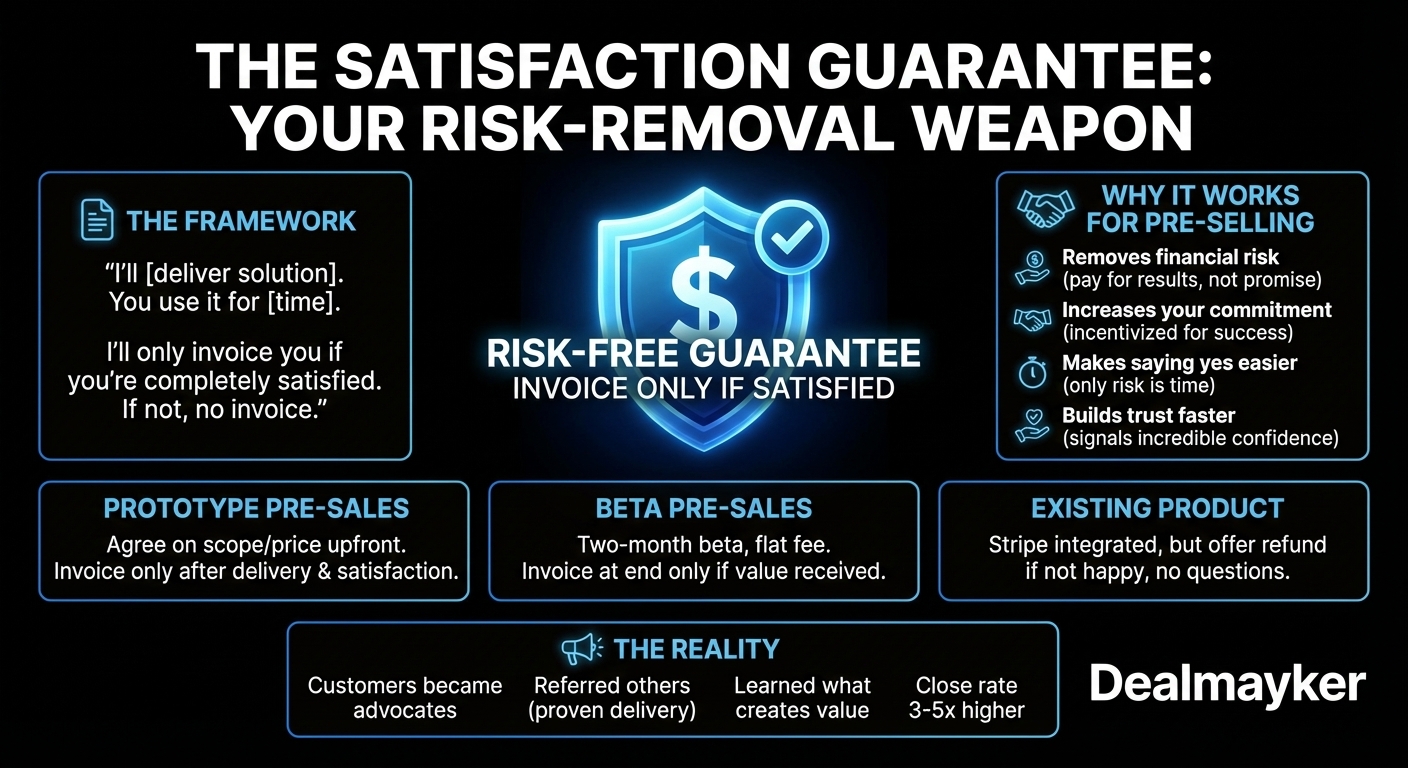
- It removes their financial risk: They're not paying for a promise - they're paying for results.
- It increases your commitment: You're incentivized to make them successful because you don't get paid otherwise.
- It makes saying yes easier: Their only risk is time, and you can minimize even that by doing most of the work for them.
- It builds trust faster: Offering to work for free if they're not satisfied signals incredible confidence.
- The customers who did pay became my biggest advocates
- They referred others because I proved I deliver
- I learned what actually creates value (vs what doesn't)
- My close rate was 3-5x higher than without the guarantee
What Counts as a "Commitment" in Pre-Selling
- Signed order form with price and start date: They agreed to specific scope and pricing
- Paid deposit: They put money down (even 20-50% deposit counts)
- Beta fee payment: They paid a flat fee for beta access
- Signed contract: Legal commitment to pay upon delivery
- Purchase order: Their company issued a PO for your solution
- Verbal "yes, we'll buy this": Good signal but not binding
- Agreement to specific price: They agreed on pricing but didn't sign anything
- Scheduled kickoff call: They committed their time to get started
- Introduced you to stakeholders: They're bringing others in to evaluate
- "This sounds interesting": Everyone says this, means nothing
- "Keep me updated": Polite way of saying not interested
- "We'll consider this for next quarter": No urgency = no real commitment
- Waitlist signup: Zero friction, zero commitment
- "Send me more info": They're not evaluating seriously
- Improve your value proposition
- Target different customers
- Solve a more urgent problem
- Reconsider if this is a real business
After Pre-Selling: Building and Delivering
- What features they assumed would exist
- What questions they asked
- What workflows they need
- What integrations matter to them
- "Here's what we built this week"
- "Here's what we're building next week"
- "Quick question: would you prefer X or Y?"
Common Pre-Selling Mistakes to Avoid
- Mistake #1: Pre-selling to people without urgency
Pre-selling only works if prospects have high importance AND high urgency for your solution. If they're mildly interested but not in pain right now, they'll say "maybe later" forever.
Only pre-sell to people with acute pain who need a solution immediately.
- Mistake #2: Making the prototype too complex
You don't need 50 screens showing every possible feature. You need 5-7 screens showing the core value proposition.
Overcomplex prototypes take too long to build and confuse prospects. Keep it simple.
- Mistake #3: Not asking for commitment on the call
Don't end the demo with "let me know if you're interested." Ask for commitment right there:
"This solves your problem. Do you want to be one of the first users? Can we fill out an order form now?"
The best time to get commitment is when they're excited, not days later.
- Mistake #4: Accepting weak commitments as validation
"That sounds cool" is not validation. "Keep me updated" is not validation. Even "we'll probably buy this" is not strong validation.
Only count: signed order forms, paid deposits, signed contracts, or purchase orders.
- Mistake #5: Building before you have 3-5 strong commitments
One customer commitment isn't enough. They might be an outlier. You need 3-5 paying commitments to validate there's a real market.
Don't start building production code until you have that validation.
- Mistake #6: Pre-selling without a clear delivery timeline
"I'll build it eventually" doesn't work. Give them a specific delivery date: "You'll get access by [date]."
This creates accountability for you and sets clear expectations for them.
- Mistake #7: Not using the satisfaction guarantee
If you're asking someone to pay for something that doesn't exist yet, remove all their risk. Offer the satisfaction guarantee.
This dramatically increases your close rate and proves you're confident in delivering value.
The two tactics that work:
- Clickable prototype demos
- Build a 5-7 screen Figma prototype (2-4 days)
- Demo it to prospects with high urgency
- Get signed order forms with price and delivery date
- Build the real product based on their commitments
- Text-message beta invites
- Compile a shortlist of 10-20 people from your network with the problem
- Send them a detailed message: what you're building, problem/solution, beta offer
- Get flat-fee commitments for closed beta
- Build and deliver to committed beta users
Both tactics require:
- Trust: Start with your network, not strangers
- Urgency: Only target people with acute pain right now
- Risk removal: Use satisfaction guarantees to make saying yes easy
- Strong commitments: Get order forms, deposits, or contracts - not "sounds interesting"
Your pre-selling action plan:
- This week: List 10 people from your network who have the problem you want to solve
- Next week: Either build a simple prototype OR write your beta invite message
- Week 3: Show the prototype or send the messages to your list
- Week 4: Have commitment conversations with interested people
Goal: Get 3-5 strong commitments (order forms, deposits, or contracts) before writing any production code
If you can't get 3-5 people to commit after seeing a compelling demo or beta offer, you don't have a business yet. You need to refine your value proposition, target different customers, or solve a more urgent problem.
But if you can get those commitments? You just validated real demand. Now you can build with confidence knowing people will actually pay for what you're creating.
Get paid before you build. That's how you avoid wasting months on products nobody wants.
Identify prospects ready to commit
Get ICP matching and deal-readiness signals to find prospects with urgency - the ones most likely to pre-commit. Start with 5 free credits.
Get Started FreeFrequently Asked Questions
What is pre-selling and why does it matter for B2B SaaS?
Pre-selling means getting paid commitments (order forms, deposits, or contracts) before you build your product. It validates real demand before you invest 3-6 months building, reduces waste by showing you exactly what customers need, provides cash flow to fund development, and gives you paying customers the day you launch instead of starting from zero.
What's the clickable prototype pre-selling tactic?
Build a 5-7 screen clickable prototype in Figma/Framer (2-4 days work) that demonstrates your core value proposition. Demo it to prospects with high urgency. If they see value, ask them to commit with a signed order form including price, scope, and start date. Then build the real product based on these commitments. This validates demand before investing months in development.
What's the text-message beta invite tactic?
Compile a shortlist of 10-20 people from your network who have your problem. Send them an individual text/DM describing what you're building, the problem it solves, outcomes, and a closed beta offer with flat-fee pricing. For DealMaker, three companies committed immediately from text messages - no prototype needed, just a clear problem/solution description and beta invitation.
How many pre-sale commitments do I need before building?
At least 3 strong commitments (signed order forms, paid deposits, signed contracts) or 5 medium commitments (verbal agreements with pricing, scheduled kickoff calls). If you can't get 3-5 people to commit after seeing your prototype or beta offer, you don't have validated demand. You need to refine your value proposition, target different customers, or solve a more urgent problem.
What counts as a "strong commitment" in pre-selling?
Strong commitments: signed order forms with price and start date, paid deposits (even 20-50%), beta fee payments, signed contracts, or purchase orders. Weak commitments that don't validate: "sounds interesting," "keep me updated," "we'll consider next quarter," waitlist signups, or "send more info." Only money or binding commitments validate real demand.
Should I use a satisfaction guarantee for pre-selling?
Absolutely. Tell prospects: "I'll invoice you only if you're satisfied. Not happy? No invoice. No questions asked." This removes all their financial risk and makes saying yes dramatically easier. For pre-sales specifically, it signals confidence and increases close rates 3-5x. Even if some customers don't pay, the ones who do become advocates and refer others.
What if I can't get anyone to commit to pre-buying?
If you can't get 3-5 commitments after showing a compelling prototype or beta offer, you have four options: (1) improve your value proposition - maybe you're not solving a painful enough problem, (2) target different customers with more urgency, (3) solve a more acute problem, or (4) reconsider if this is a viable business. "People like the idea" is not the same as "people will pay for it."
How detailed should my prototype be for pre-selling?
Keep it simple: 5-7 screens maximum showing the core workflow and value proposition. Don't build every feature - focus on demonstrating the "aha moment." If you can't sell someone on 5 screens, adding 45 more won't help. Overcomplex prototypes take too long to build and confuse prospects. The goal is to demonstrate value convincingly, not showcase comprehensive features.