Customer Intent Signals for Customer Success: What They Mean and How to Act
Why having customer health data does not mean you are reading it correctly
The Problem: Signals Without Interpretation
When your champion moves roles or leaves the company, that looks like bad news. And it is, if they were your only relationship. But if you have been doing stakeholder mapping and multi-threading from the start, it is just a transition.
When my HR champion at a Fortune 500 company moved to a subsidiary, I did not panic. I had spent months doing the unglamorous work: leading 50-person Zoom kickoffs where no one turned their cameras on, running a virtual roadshow across 20 facilities in different states. Then I looked at the data: login metrics, facility by facility, week over week. Who was taking the assignment seriously and making meaningful change? Who was ticking the box with no real impact? I synthesised what I learnt, presented it to their SVP, and we doubled the program (and our ACV to boot).
That only happened because I had relationships at every level before I needed them. In the cases where we did not multi-thread, we were starting from scratch with no context. It felt like selling all over again.
The signal matters. But how you prepare for it matters more.
The Deeper Problem: Infrastructure and Impossible Expectations
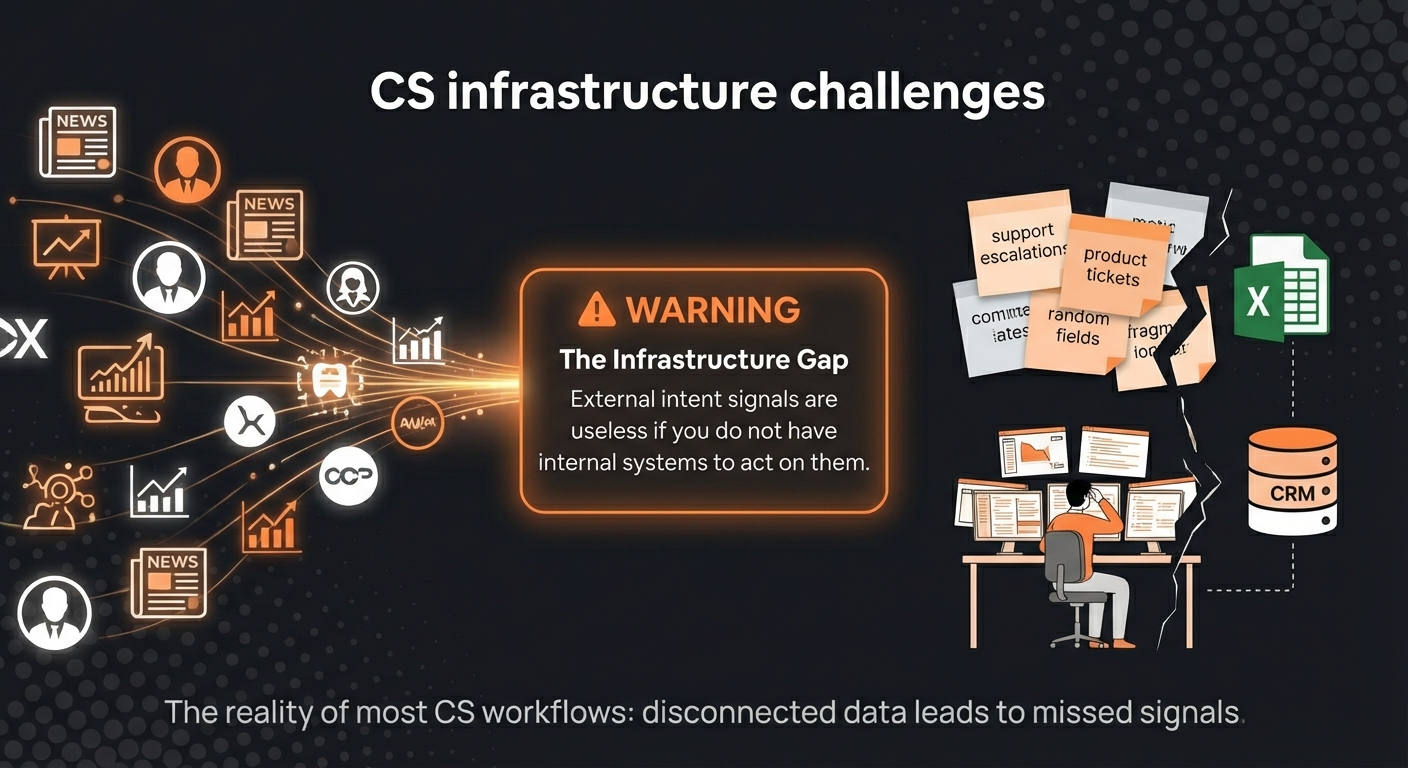
Most CS teams do not have the infrastructure to act on signals even when they see them. Customer Success often does not get thought of when companies implement a CRM. It is built for sales teams, and CS has to figure out their own way of managing post-sales workflows. Notes get jotted down in random fields and records. You are scrolling through fragmented notes trying to piece together continuity.
When did you last have a real check-in with each customer? Has it been two weeks since they responded to your email? If you are managing dozens of accounts and tracking touchpoints in a spreadsheet, you already have blind spots.
That is when the real problems slip through. Usage dropping quarter over quarter. Engagement declining. Key stakeholders going quiet. You do not notice until you are 30 days from renewal and you finally pull the reports and realise: this should have been addressed weeks ago.
External signals - news about your customer's company, executive turnover, new funding, competitor activity - only help if you have the internal infrastructure to notice and act on them in the moment. Otherwise, you are just collecting more data you do not have time to use.
What Actually Works: Stop Trying to Know Everything
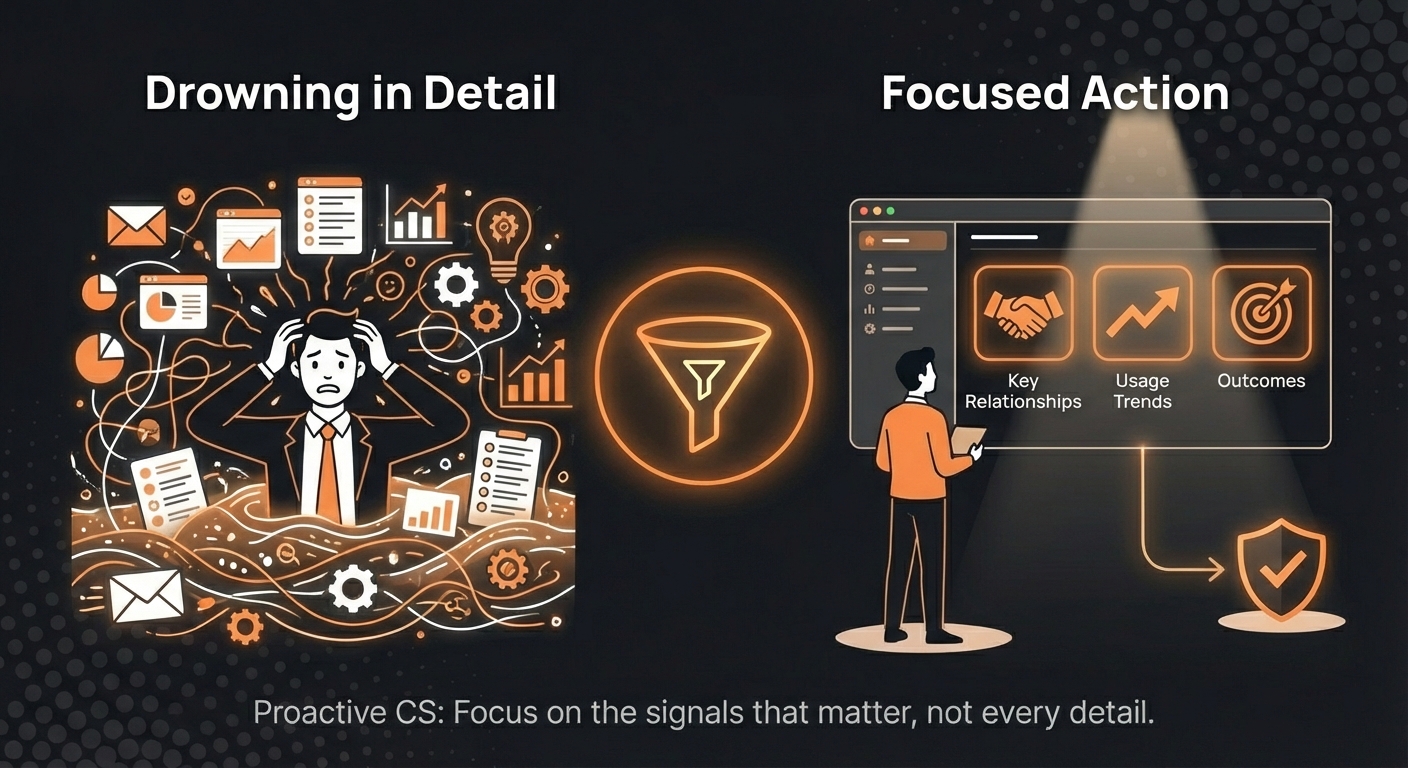
The best CS professionals are not the ones with the most detailed notes. They are the ones who know which signals matter, which relationships to invest in, and when good enough is actually good enough.
Build relationships with multiple stakeholders before you need them. Do not wait until your champion leaves to start mapping the org chart. Do not wait until renewal to look at usage trends. Do not wait for the customer to tell you they are unhappy to check in on outcomes.
Proactive monitoring beats reactive scrambling. But proactive monitoring requires systems and choices, not just good intentions.
If you are trying to give every account strategic white-glove treatment, you are not being thorough. You are setting yourself up to fail. Scale requires choices. Not every relationship needs to be deep. Not every signal needs action. Know the difference, or burn out trying.
Monitor customer health signals automatically
Dealmayker tracks executive changes, funding rounds, hiring trends, and competitor activity for your accounts - so you can act on signals before they become churn risks.
Try FreeThe Payoff: Managing Health, Not Firefighting Churn
You are managing customer health, not firefighting churn.
Intent signals are powerful. Tools like Dealmayker can surface context about funding rounds, executive changes, hiring trends, competitor activity - things that would take hours to research manually. But the signal is only as good as your ability to interpret it and act on it.
The same principles that help sales teams identify relevancy, timing, and trust apply to customer success. Just like your first customers came from trusted relationships, retention depends on maintaining those relationships at scale.
Context without questions is just noise. If you are managing accounts without the infrastructure to turn signals into action, you are not doing customer success. You are just reacting louder.
Stop firefighting churn, start managing health
Get real-time intent signals and contextual intelligence for your customer accounts. Know when to reach out, what to say, and how to prevent churn before renewal conversations.
Get Started FreeFrequently Asked Questions
What are customer intent signals in Customer Success?
Customer intent signals are behavioral and external indicators that suggest changes in account health, expansion opportunity, or churn risk. Examples include executive turnover, usage pattern changes, competitor mentions, funding announcements, or stakeholder engagement shifts. The key is interpreting what these signals mean in context, not just collecting them.
How do you multi-thread customer success accounts?
Multi-threading means building relationships with multiple stakeholders across different levels and departments before you need them. Map the org chart proactively, not reactively. When your champion leaves, you should already have 3-4 warm relationships with decision-makers, end users, and executives. This prevents you from starting from scratch during transitions.
What infrastructure does a CS team need to act on intent signals?
CS teams need centralized account visibility (not fragmented notes in CRM fields built for sales), automated signal monitoring (executive changes, funding, hiring trends), clear prioritization frameworks (which signals require action vs monitoring), and defined workflows for turning signals into interventions. Without infrastructure, signals become noise you do not have time to use.
Should CS teams monitor every account with the same level of detail?
No. Scale requires ruthless prioritization. Not every relationship needs to be deep, and not every signal needs action. High-value accounts with complex stakeholder maps deserve strategic attention. Lower-tier accounts need lightweight monitoring with automated signals. Trying to give every account white-glove treatment guarantees you will fail at all of them.
When should you start worrying about a competitor mention from a customer?
Context matters more than the signal itself. A competitor mention could mean they are actively churning, or it could be due diligence from a new stakeholder validating the vendor stack. Ask questions: Is this coming from your champion or a new exec? Are they asking about specific features or pricing? Have usage trends changed? The signal is a starting point for conversation, not a panic button.
How can CS teams prevent churn before renewal conversations?
Proactive monitoring beats reactive scrambling. Track usage trends quarter over quarter, not 30 days before renewal. Build multi-threaded relationships before your champion leaves. Monitor external signals (funding, hiring, exec changes) that indicate business shifts. Check in on outcomes regularly, not just during QBRs. When you manage health proactively, renewals do not feel like scrambles.